How to Trade Futures During High-Impact News Events
NFP, CPI, FOMC — Trade The Volatility, Don’t Fear It
A numbers-driven playbook for ES, NQ, GC and CL contracts around the biggest news releases of the month.
Table of Contents
Yes, you should trade futures during high-impact news events like NFP, CPI, or FOMC — but only with position sizing tied to your account’s trailing drawdown, wider stops that account for slippage, and a clear read on whether you’re in an evaluation or a funded account. High-impact news creates the sharpest, most liquid moves of the month on ES, NQ, GC, and CL, and skipping it means skipping some of the best risk-reward setups futures markets offer — provided your size matches your drawdown cushion. That’s the heart of how to trade futures during high-impact news events without letting one bad tick wipe out weeks of progress.
Most retail guides either tell you to stay flat during news (safe but expensive in missed opportunity) or throw generic « widen your stop » advice without tying it to actual account math. Prop firms make it worse: many impose blanket news-trading bans or blackout windows that force you to sit out NFP, CPI, and FOMC entirely — even once you’re trading with real capital.
This guide takes a different angle. We walk through trading futures during economic news using real dollar figures — $190, $290, and $490 evaluation plans, their trailing drawdown limits, and how much size you can actually carry into a news print without breaching your account. We’ll also draw the line between the caution required during evaluation challenges and the freedom that comes once you’re funded — because those two phases call for genuinely different playbooks.
By the end, you’ll have a concrete news trading strategy futures traders can use on ES, NQ, GC, and CL — plus the exact reasoning behind why a firm’s rulebook (not just your strategy) determines whether news trading is even viable for you.
- Trade using TickWise allocated capital
- Guaranteed payout
- Unlimited withdrawals, anytime
Should You Trade News at All?
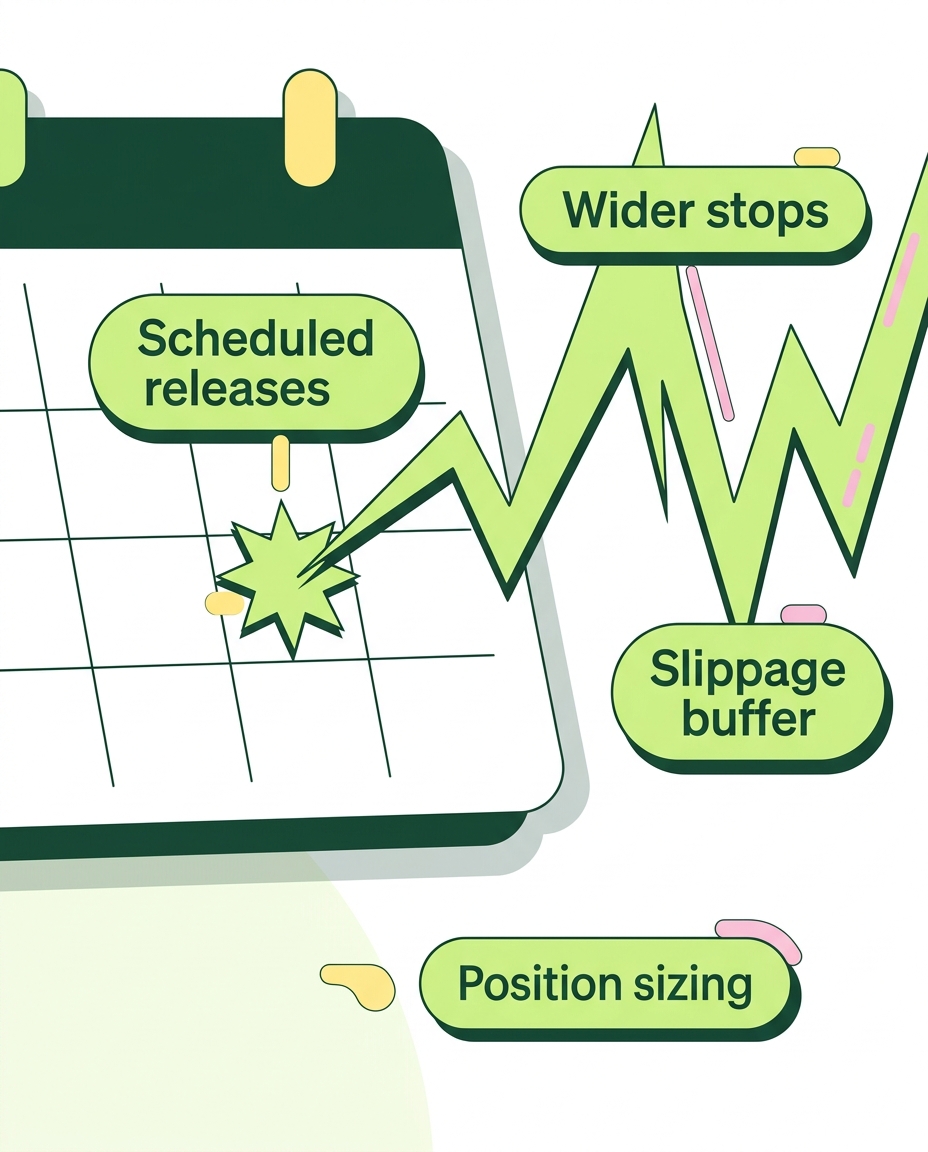
High impact news futures volatility isn’t optional background noise — it’s where a disproportionate share of the month’s directional range gets made. NFP (first Friday of the month), CPI, and FOMC rate decisions routinely produce 20-40+ point moves on ES within the first two minutes, and even larger percentage swings on NQ and GC. Traders who avoid every single news print are also avoiding some of the cleanest trend initiations available.
The real question isn’t « trade or don’t trade » — it’s « trade with what size, what stop, and under what account rules. » That’s where most retail content stops short. Generic risk management articles say « reduce size » without saying by how much, and prop firm policy pages just say « no trading 2 minutes before/after release » without explaining the reasoning.
ℹ️ The core distinction: Your ability to trade news isn’t just a strategy question — it’s a function of your account’s trailing drawdown cushion, your firm’s specific news-trading rules, and which phase (evaluation or funded) you’re currently in.
A trader with a wide trailing drawdown and permissive rules can scale into NFP with a plan. A trader in a tight evaluation with an active news blackout has no choice but to stand aside — not because the setup is bad, but because the account structure makes it a rule violation. Understanding futures trading economic calendar strategy for beginners starts with knowing which category you’re in before you even look at a chart.
Evaluation vs Funded: Two Different Risk Realities
This is where the prop firm world diverges sharply from a self-funded retail account — and where most competing content gets it wrong by treating « prop firm rules » as one uniform thing. In reality, prop firm news trading rules vary enormously firm to firm, and the gap between evaluation-phase restrictions and funded-phase freedom is often the single biggest factor in whether news trading is even worth attempting.
Firms like Alpha Futures and My Funded Futures explicitly restrict or ban trading around high-impact releases — often with blackout windows of several minutes before and after NFP, CPI, and FOMC, sometimes extending the restriction well into the funded phase too. That’s a defensible risk-control decision from the firm’s side, but it also means traders on those platforms can never fully test or monetize a news-trading edge, even once they’ve proven themselves with real funded capital. See how TickWise compares to My Funded Futures for the full rule-by-rule contrast.
TickWise takes a different position: caution during the evaluation, freedom once funded. During your evaluation, the same trailing drawdown and daily loss limits that govern every other trading day also govern news days — no special blackout, but also no relaxed cushion. This is where the caution really matters, since a single slippage event can chew through a meaningful chunk of your evaluation’s trailing drawdown before you’ve banked any progress toward your profit target.
Once funded, though, TickWise applies no additional trading rules. Same contracts, same size, same instruments as your evaluation — full trading power, no news-trading ban, no blackout window, no special permission process. You manage news-event risk with your own sizing discipline, not because a rulebook forces you to sit on your hands during the most liquid ten minutes of the month.
💡 Practical takeaway: Treat evaluation-phase news trading as risk-reduction practice — smaller size, wider stops, tighter contract counts. Once funded, that same discipline becomes a choice, not a rule, because TickWise doesn’t impose funded-account news restrictions.
The Numbers: Drawdown Math Per Plan
Futures trading risk management news decisions should always start with your trailing drawdown limit, because that number — not your P&L target — is what actually ends your account. Here’s how the three TickWise plans line up, and what that means for realistic news-event risk sizing.
| Plan | Fee | Account Size | Contracts | Trailing Drawdown | Funded Size |
|---|---|---|---|---|---|
| Starter | $190 | $25,000 | 3 | $1,500 | $2,500 |
| Pro | $290 | $50,000 | 6 | $3,000 | $5,000 |
| Expert | $490 | $100,000 | 10 | $5,000 | $10,000 |
Now apply real slippage. A sharp NFP surprise can move ES 15-25 points in seconds; on a full 3-contract Starter position, that’s $750-$1,250 of adverse movement before you even react — potentially over half your entire $1,500 trailing cushion in one release. Read the full breakdown of understanding trailing drawdown mechanics to see exactly how the trailing calculation locks in that damage.
Max Acceptable News-Event Risk Per Plan (Rule of Thumb)
- Starter ($190 / $1,500 DD): cap risk per news trade at $300-$450 (20-30% of cushion) — often means 1 contract, not 3
- Pro ($290 / $3,000 DD): cap risk per news trade at $600-$900 — 2-3 contracts, not the full 6
- Expert ($490 / $5,000 DD): cap risk per news trade at $1,000-$1,500 — 3-5 contracts, not the full 10
This is the missing piece most guides skip: sizing down for news isn’t optional caution, it’s math. Since the same contracts in both phases mean the same trading power once you’re funded, this sizing discipline should carry over — you’re simply no longer forced into it by a rule, you’re choosing it because it protects your funded payouts.
How to Trade Futures During High-Impact News Events by Contract
Different contracts behave differently around the same news release, and how to trade futures during high-impact news events changes meaningfully depending on whether you’re on an index, metal, or energy contract.
ES and NQ During NFP and FOMC
ES and NQ are the most liquid index futures and typically see the tightest spreads even during volatility spikes — but NQ’s higher beta means bigger point swings on the same headline surprise. During FOMC, expect two distinct volatility waves: the initial statement release, then a second (often larger) move during the press conference Q&A. Many experienced news traders skip the first spike entirely and wait for the retest or the press-conference confirmation.
GC During CPI Releases
Gold futures react sharply to CPI surprises because inflation data directly repriced rate-cut expectations. GC can gap and then reverse hard within minutes as the market digests core vs headline figures. Because gold’s tick value is larger per point than ES, position sizing needs an extra downward adjustment during CPI weeks — see trading gold futures around volatile releases for contract-specific stop placement.
CL During Inventory and Macro News
Crude oil doesn’t just move on NFP/CPI/FOMC — EIA inventory data adds a second, CL-specific news layer most futures traders trading only ES/NQ never account for. CL’s volatility can spike violently on unexpected inventory builds or draws, independent of the broader macro calendar. For a full breakdown of setups, see day trading setups for crude oil contracts.
ℹ️ CFDs vs Futures during news: If you’ve traded CFDs before, expect a different experience on regulated futures. CFD brokers frequently widen spreads or requote during NFP/CPI, effectively taxing your entry and exit. Futures trade on a centralized, regulated order book with visible depth — spreads can still widen, but the mechanism is transparent price discovery rather than broker-side spread manipulation.
A Practical News-Trading Playbook
Trading around economic calendar events works best as a repeatable process, not a one-off gut call. Here’s a structure that respects both the evaluation-phase caution and the funded-phase freedom described above.
Know the calendar 24 hours ahead
Mark NFP (first Friday), CPI (mid-month), and FOMC (eight times a year) dates in advance. Note the exact release time and avoid entering fresh swing positions right before, regardless of phase.
Size down before the print
Use the per-plan risk caps above. If you’re on Starter, that likely means trading 1 contract into the release even though your account allows 3.
Widen stops to account for slippage
A stop that works fine in normal conditions can get blown through by 5-10 ticks during NFP or FOMC. Build that gap into your risk calculation before entry, not after a bad fill.
Wait for the second move if unsure
The first 60-90 seconds after a release are often the least reliable. Many funded traders let the initial spike pass and trade the retest or confirmation leg instead.
Once you’re funded and the « no rules once funded » policy applies, this same playbook still matters — it’s just no longer enforced by a firm’s blackout window. For a broader look at ongoing discipline beyond news days, see broader risk management once you’re funded.
⚠️ Avoiding slippage: How to avoid slippage trading futures news events comes down to three things — smaller size going into the release, limit orders instead of market orders where feasible immediately after the spike, and never adding to a losing news position hoping for a reversal.
Frequently Asked Questions
How to trade futures during NFP news release specifically?
Reduce size to a fraction of your normal contract count, avoid entering in the first 60-90 seconds of unpredictable whipsaw, and use the pre-release consolidation range as your reference for stop placement once you do enter.
What are the best futures to trade during a FOMC announcement?
ES and NQ are the most commonly traded during FOMC due to deep liquidity, though GC often produces the sharpest secondary reaction once rate-path expectations shift. Stick to contracts you already know well rather than experimenting on FOMC day.
Can you trade during news on a funded futures account with TickWise?
Yes. TickWise applies no rules once funded, meaning no news-trading blackout or ban on funded accounts — unlike firms that restrict news trading even after you’ve been funded. Evaluation accounts still call for the standard trailing drawdown and daily loss discipline described above.
What’s the difference between news trading rules during a prop firm evaluation vs a funded account?
During evaluation, every firm (including TickWise) expects you to respect the same trailing drawdown and daily loss limits on news days as any other day — there’s no special leniency. Some competitors add outright blackout windows on top of that. Once funded, TickWise removes additional restrictions entirely, while several competitors continue enforcing news blackouts indefinitely.
Which TickWise plan fits my news-trading risk tolerance?
If you’re testing a news strategy for the first time, Starter’s $1,500 trailing drawdown forces the tightest discipline. Pro and Expert give more cushion to size a genuine multi-contract news play. Compare the full breakdown when choosing between the $190/$290/$490 plans.
Your Path to Trading News Events With Real Capital
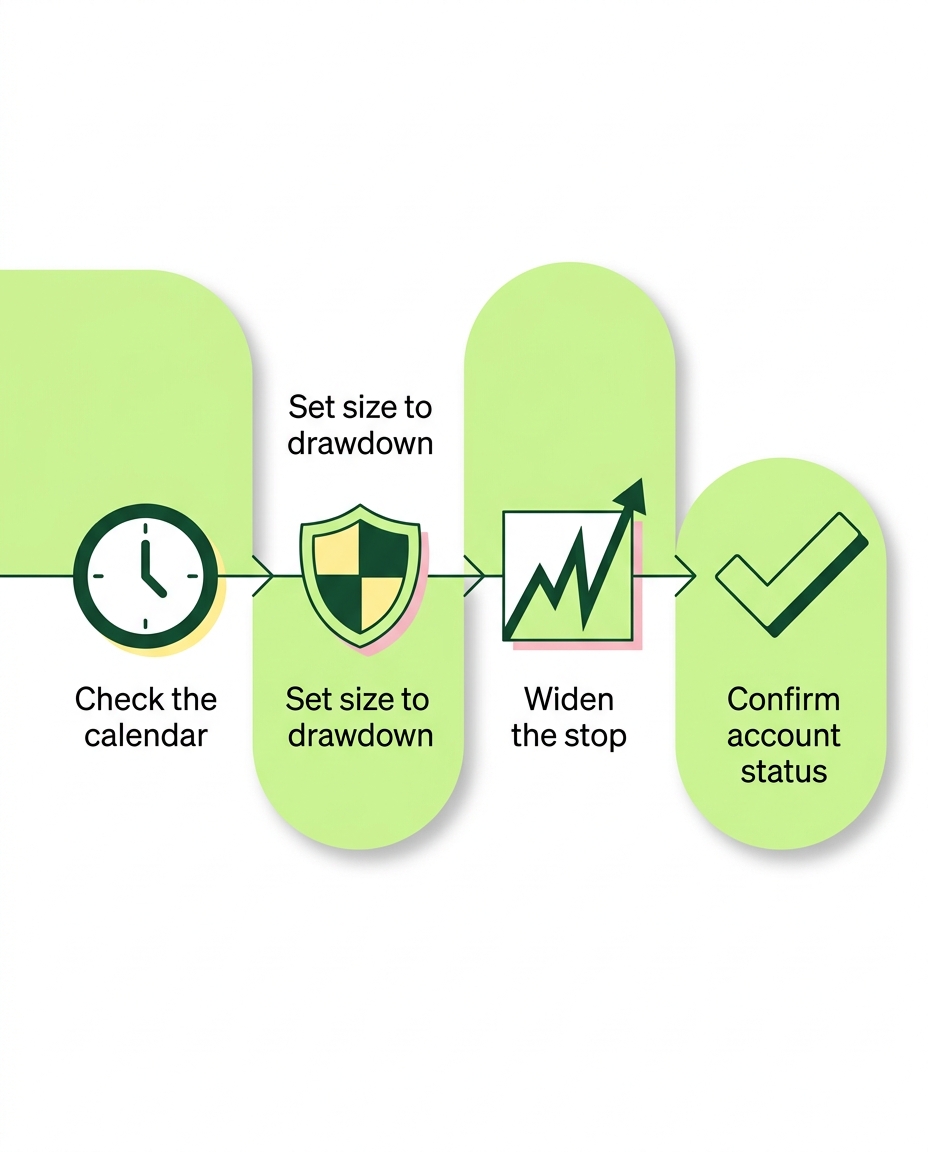
Pick Your Plan
Choose Starter, Pro, or Expert based on the drawdown cushion you want going into news weeks.
Trade the Evaluation With Discipline
Apply size caps and wider stops on NFP, CPI, and FOMC days while proving consistency toward your profit target.
Get Funded
Move to a funded account with the same contracts and same trading power — no news-trading rule changes.
Trade News on Your Terms
With no rules once funded, size news trades based on your own risk management, not a blackout window.
🚀 Start Your TickWise Evaluation →
⚠️ Risk Disclaimer: Trading futures involves substantial risk of loss and is not suitable for all investors. High-impact news events like NFP, CPI, and FOMC can produce rapid, unpredictable price movement and slippage. Past performance is not indicative of future results. Only trade with capital you can afford to lose. This article is for informational purposes and does not constitute financial advice.