VWAP Strategies for Futures Day Trading
Trade the Anchor, Not the Noise
VWAP strategies for futures day trading only work when position size respects the account rules underneath them. Here’s how to build both.
Table of Contents
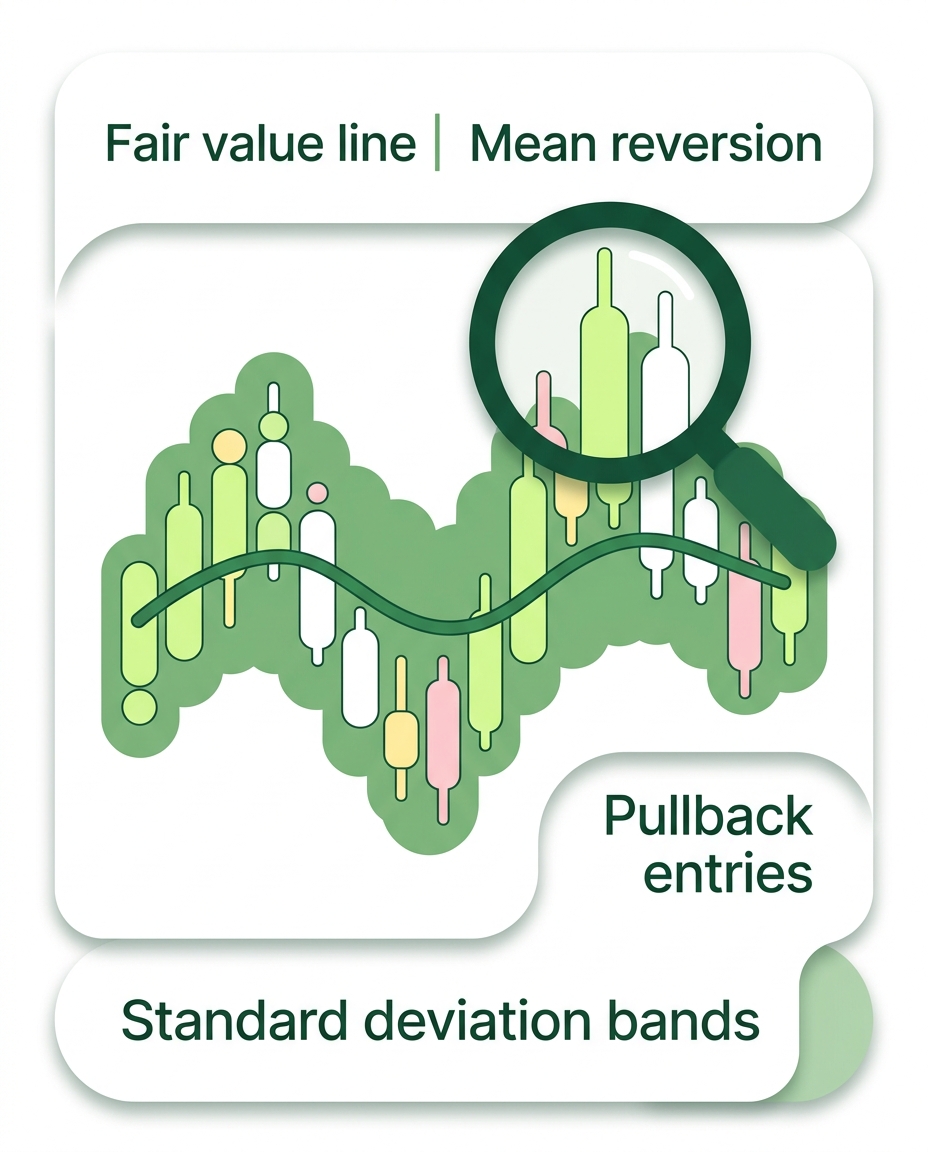
What is a VWAP strategy in futures day trading? It’s a set of rules for entering and exiting ES, MES, NQ, or GC contracts around the volume-weighted average price — the single line that shows where the « fair value » of the session actually sits. A VWAP trading strategy typically does one of two things: fade price back toward VWAP when it stretches too far (mean reversion), or buy/sell a pullback into VWAP when the day is trending (continuation). Most retail explanations stop there. For a funded futures account, that’s only half the strategy.
The other half is sizing. VWAP futures indicator signals don’t come with a built-in stop-loss or contract count — you have to attach both, and the correct numbers change depending on whether you’re still inside a TickWise evaluation or already trading a funded account. During evaluation, every VWAP mean-reversion entry has to respect the daily loss limit and trailing drawdown baked into your plan. Once funded, the « no rules once funded » structure lets you scale size on your highest-conviction VWAP reclaims — the same setup, traded with more contracts, because the constraint that mattered during evaluation no longer applies the same way.
This guide treats VWAP not as a magic line but as a risk-management filter. We’ll walk through the mean-reversion and pullback setups, the standard deviation bands that tell you when a fade is statistically extended, and — critically — the exact contract sizing for ES/MES/NQ/GC across TickWise’s $190 Starter, $290 Pro, and $490 Expert plans. Session timing matters here too: VWAP anchors to the regular trading hours (RTH) open and resets daily, so understanding session timing and RTH market hours is the first building block before any VWAP setup makes sense.
By the end, you’ll have a mechanical, numbers-driven framework — tick-value stop distances, contract caps per tier, and clear rules for when a VWAP setup is worth trading at all inside a prop firm structure.
🚀 Start Your TickWise Evaluation →
- Trade using TickWise allocated capital
- Guaranteed payout
- Unlimited withdrawals, anytime
What Is a VWAP Strategy in Futures Day Trading?
VWAP (volume-weighted average price) is the running average price of a contract, weighted by the volume traded at each price, recalculated tick by tick from the RTH session open. Institutions use it as a benchmark for execution quality — if a large order fills below VWAP on a buy, that’s considered a good fill. Day traders borrow the same logic to gauge whether current price is « cheap » or « expensive » relative to the session’s real activity.
A VWAP trading strategy generally falls into one of three buckets: mean reversion (fade extreme deviations back to the line), pullback/continuation (enter in the direction of the trend when price retraces to VWAP), and breakout confirmation (use a VWAP reclaim or rejection to validate a level break). All three are mechanical if you define entry, stop, and target in ticks rather than « feel. » The VWAP futures indicator is available on every major platform — NinjaTrader, Tradovate, Sierra Chart — usually with standard deviation bands plotted alongside it, which is what turns a single line into a full VWAP mean reversion strategy.
What makes this different for a funded account is that the strategy’s edge is only realized if the position size survives the account’s risk rules on a losing streak. A textbook VWAP pullback strategy might call for 1% risk per trade — but 1% of a $50,000 evaluation account is $500, which is your entire daily loss limit at the Pro tier. That’s the gap most VWAP guides never address.
VWAP Mean Reversion Strategy: The Core Setup
The VWAP mean reversion strategy works best in range-bound, low-catalyst sessions — no major data release, no FOMC, no NFP. The setup: price stretches 1.5 to 2 standard deviations away from VWAP, momentum stalls (a lower high on a 1-minute chart for a short, a higher low for a long), and you fade back toward the VWAP line itself, not through it.
Concrete example on ES: VWAP sits at 5,420, price rallies to 5,432 (roughly 2 standard deviations above), and you see a rejection candle. Entry short at 5,431, stop at 5,435 (16 ticks, $200 per contract on ES at $12.50/tick), target at VWAP (5,420, or 44 ticks). That’s a 1:2.75 risk-reward ratio before commissions — a strong number, but only if you’re sized to survive being wrong two or three times in a row without breaching your daily loss limit.
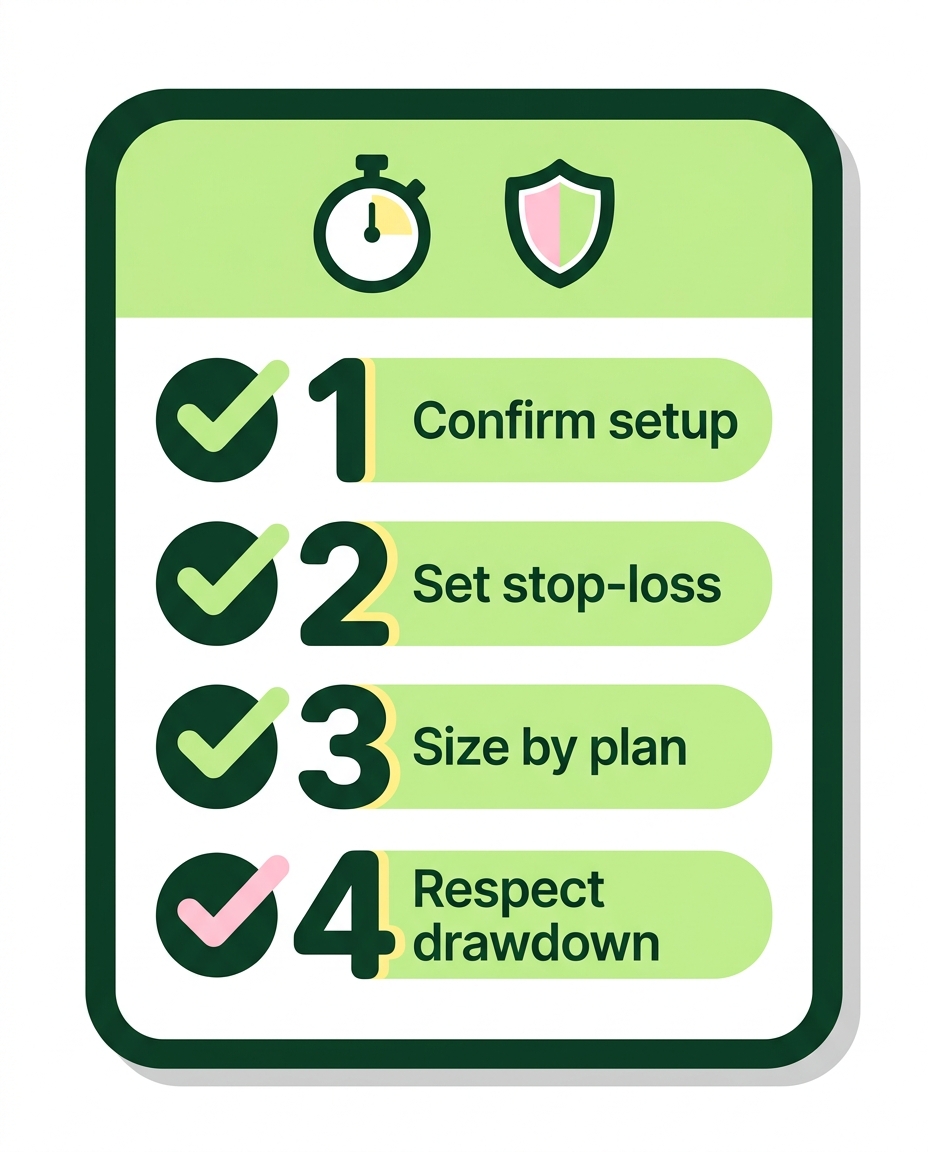
Mechanical checklist for a VWAP mean-reversion entry: (1) price is 1.5–2 SD from VWAP, (2) no major news in the next 15 minutes, (3) volume is declining into the extreme (exhaustion, not acceleration), (4) stop is placed beyond the extended high/low, never at an arbitrary tick count.
On MES, the same 16-tick stop only costs $20 per contract ($1.25/tick), which is exactly why MES is the instrument of choice for smaller evaluation accounts learning this setup — you get the identical price structure with a fraction of the dollar risk.
VWAP Pullback Strategy for Trend Days
The vwap pullback strategy futures traders lean on during genuine trend days is the opposite instinct from mean reversion: instead of fading a stretch, you buy or sell the retracement back into VWAP in the direction the day is already moving. If ES has been grinding higher all session, printing higher highs and higher lows above VWAP, a pullback that taps the VWAP line (or the first standard deviation band) without closing below it is a continuation entry, not a reversal signal.
Example: NQ trending up, VWAP at 19,850, price pulls back to 19,855 and holds. Entry long at 19,857, stop at 19,845 (12 ticks on NQ, where 1 tick = $5, so $60/contract risk), target at the prior session high or a measured move — often 2-3x the risk. This setup depends entirely on correctly identifying trend days versus range days, which is why pairing VWAP with volume context matters: pairing volume profile with your entries tells you whether the pullback is happening on shrinking volume (healthy continuation) or expanding volume (potential reversal).
How to use VWAP on ES futures for a pullback entry
On ES specifically: wait for price to close above VWAP for at least three consecutive 5-minute bars before treating any pullback as a continuation setup rather than noise. This filters out the whipsaw that happens in the first 30-45 minutes of RTH, when VWAP hasn’t accumulated enough volume to be a reliable anchor yet.
Standard Deviation Bands and Best VWAP Settings
VWAP standard deviation bands futures trading setups typically plot 1, 2, and 3 SD bands above and below the anchor line. The best vwap settings for day trading futures depend on the instrument’s volatility profile, but a reasonable starting point across ES, MES, NQ, and GC is: 1 SD for early-warning (tighten stops, take partials), 2 SD for mean-reversion entries, and 3 SD reserved for outlier, high-conviction fades that only trigger a few times a month.
| Instrument | Tick Value | Typical 2SD Stop (ticks) | Dollar Risk / Contract |
|---|---|---|---|
| ES (E-mini S&P) | $12.50 | 14–18 | $175–$225 |
| MES (Micro S&P) | $1.25 | 14–18 | $17.50–$22.50 |
| NQ (E-mini Nasdaq) | $5.00 | 10–14 | $50–$70 |
| GC (Gold) | $10.00 | 8–12 | $80–$120 |
Anchoring the VWAP reset to the RTH session open — rather than a 24-hour or overnight anchor — is the setting that matters most for prop firm traders, because it aligns the indicator with the daily loss limit reset and the trailing drawdown calculation, both of which are also tracked on a session basis. Trading a VWAP calculated from the overnight Globex session against RTH-based account rules is a common mismatch that produces false signals.
Position Sizing VWAP Trades by TickWise Account Tier
This is the section most VWAP content skips entirely. A VWAP day trading setup is only as good as the contract count behind it, and how contract size scales with account tier is non-negotiable during evaluation — trade outside these numbers and a single bad mean-reversion fade can put the daily loss limit or trailing drawdown at risk.
| Plan | Price | Account Size | Max Contracts | Daily Loss Limit | Suggested VWAP Size (2SD fade) |
|---|---|---|---|---|---|
| Starter | $190 | $25,000 | 3 | $500 | 1 MES or 1 ES per setup |
| Pro | $290 | $50,000 | 6 | $1,000 | 2 ES or 4-5 MES per setup |
| Expert | $490 | $100,000 | 10 | ~$2,000 | 3-4 ES or full MES equivalent |
Take the Starter tier: a $175 stop on a single ES contract already consumes 35% of the $500 daily loss limit on one trade. That’s why most Starter-tier traders working a VWAP mean-reversion strategy should default to MES, where the same 2SD setup risks roughly $20-$22.50 — allowing three to four attempts at the setup within the same daily limit if the first two are stopped out. At the Expert tier with a $2,000 daily loss limit and 10 contracts available, you can run 2-3 ES contracts per VWAP fade and still have room for a second, uncorrelated setup the same session.
VWAP for Prop Firm Traders: Evaluation vs Funded Sizing
The vwap mean reversion strategy prop firm traders should run during evaluation is more conservative than the one they’ll run once funded, and the reason is entirely mechanical: how trailing drawdown actually works means every unrealized gain temporarily raises your floor, so a VWAP fade that goes against you right after a winning streak eats into buffer you thought you had locked in. During evaluation, the discipline is: size to the daily loss limit, not to the trailing drawdown ceiling — the daily limit will stop you out long before the trailing drawdown becomes the binding constraint on a single VWAP trade.
This is also where broader risk rules for funded traders apply directly to VWAP execution: cap risk per VWAP setup at roughly 20-25% of the daily loss limit, take no more than 3 VWAP attempts per session regardless of tier, and never average down into a failed mean-reversion fade — if price blows through your 2SD stop and keeps going to 3SD, that’s a trend day disguised as a range day, and the setup is invalidated, not « more attractive. »
Once funded, « no rules once funded » changes the calculus entirely. The daily loss limit and trailing drawdown mechanics that governed evaluation-phase sizing no longer constrain you the same way, which means a high-conviction VWAP reclaim — price closing back above VWAP with strong volume after a failed breakdown — can be sized up meaningfully. A funded Expert-tier trader who ran 2 ES contracts per fade during evaluation might run 5-6 ES contracts on the exact same VWAP reclaim setup post-funding, because the constraint that capped size before no longer applies in the same form. That’s precisely scaling size once you’re funded means in practice — same setup, same rules of engagement, larger size because the account structure allows it.
Key distinction: the VWAP setup itself doesn’t change between evaluation and funded phases. What changes is contract count, and that’s a sizing decision governed by account rules — not a signal quality decision governed by the chart.
FAQ
What is a VWAP strategy for futures prop trading accounts specifically?
It’s the same mean-reversion or pullback logic used in retail VWAP trading, but with position size capped to the account’s daily loss limit and trailing drawdown rather than a flat percentage-of-equity rule. On a prop account, the VWAP setup and the sizing rule are inseparable — trading the identical entry with retail-style 1% risk sizing can breach a $500 daily limit in a single stopped-out trade.
How do I use VWAP on ES futures without over-risking a funded account?
Anchor VWAP to the RTH session open, wait for at least three 5-minute bars of confirmation before treating a pullback or fade as valid, and size the stop in ticks first, then translate that into contracts based on your remaining daily loss limit — not the other way around.
What’s the best VWAP mean reversion strategy for a prop firm evaluation?
Fade only 2SD-or-greater extensions, in the absence of major news, using MES or a single ES contract at the Starter tier, capping each attempt at roughly 20-25% of the daily loss limit and stopping after three failed attempts in one session.
Do VWAP contract sizes change once I’m on a funded account?
Yes. During evaluation, sizing is capped by the daily loss limit and trailing drawdown. Once funded, those specific constraints ease under a « no rules once funded » structure, so high-conviction VWAP reclaims can be sized up. Review comparing the $190/$290/$490 account tiers to see exactly how contract caps differ by plan before you scale.
A Simple Path to Trading VWAP on a Funded Account
Choose Your Evaluation
Pick the Starter ($190), Pro ($290), or Expert ($490) plan that matches the contract count your VWAP setups need.
Trade VWAP Within the Rules
Run mean-reversion and pullback setups sized to the daily loss limit and trailing drawdown for your tier.
Get Funded
Pass with the same contract count you traded in evaluation — same trading power carries straight through.
Scale High-Conviction Setups
Once funded, size up on your strongest VWAP reclaims under the no-rules-once-funded structure.
📊 Trade VWAP on a Funded Account →
⚠️ Risk Disclaimer: Trading futures involves substantial risk of loss and is not suitable for all investors. VWAP strategies and the numbers shown here are illustrative and do not guarantee any particular outcome. Past performance is not indicative of future results. Only trade with capital you can afford to lose. This article is based on publicly available information as of July 2026.