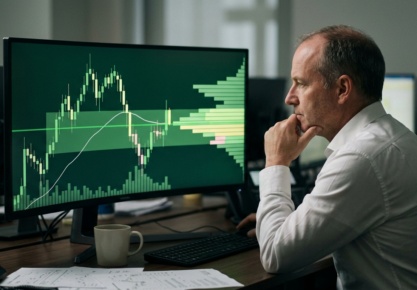
Best Prop Firm for Algo Trading in 2026
Automated Strategies Need A Firm Built For Futures
Not another forex CFD broker gesturing at « EAs allowed. » A structural answer for algo traders who want real contracts, transparent math, and zero rulebook once funded.
Table of Contents
- What Is The Best Prop Firm For Algo Trading?
- Futures vs CFDs: Why Structure Matters For Algos
- Prop Firm EA Rules: What Actually Gets You Disqualified
- Trailing Drawdown Math For Automated Strategies
- TickWise Plans For Algo Traders: $190 / $290 / $490
- France & EU Tax Angle: Futures vs CFD Algo Profits
- FAQ
The best prop firm for algo trading in 2026 is one built around futures contracts, not CFDs — because futures give automated strategies deep liquidity, no swap fees, transparent trailing drawdown math, and no dealing-desk conflicts that quietly work against a bot’s fills. TickWise Funding answers this directly with $190/$290/$490 one-time evaluations, real allocated capital, and a « no trading rules once funded » policy that lets expert advisors and algorithmic systems run without hidden restrictions.
Most content ranking for « algo friendly prop firm » or « prop firm EA rules » is written for forex and CFD brokers, where allowing an expert advisor is treated as a marketing bullet point buried next to a forbidden-practices page. That framing misses the real question for a serious systematic trader: which execution environment is structurally suited to automated strategies in the first place? Futures contracts trade on regulated, centralized exchanges with public order books — a fundamentally different environment from CFD dealing desks that can internalize your flow.
This matters more in 2026 than it did a few years ago. Latency-sensitive tick scalping, multi-timeframe EAs, and signal-driven bots are common enough that firms now have explicit stances on bots and signals allowed, HFT-style order frequency, and how trailing drawdown recalculates on every tick an algo touches. Read our broader guide to futures prop trading first if you’re new to the funded-futures model — it covers evaluation structure, funded-stage mechanics, and payout logistics that this article builds on.
What follows is a practical breakdown: why futures beat CFDs for algorithmic execution, what « no restrictions on algo trading » actually means in a rulebook, how trailing drawdown interacts with an EA’s equity curve tick by tick, and the concrete pricing and drawdown numbers TickWise publishes instead of hiding behind « contact for pricing. »
⚙️ Start Your Algo-Friendly Evaluation →
- Trade using TickWise allocated capital
- Guaranteed payout
- Unlimited withdrawals, anytime
What Is The Best Prop Firm For Algo Trading?
Ranking a « best prop firm for algo trading » list only makes sense once you fix what « algo trading » means operationally. It is not one uniform activity — it spans low-frequency signal-following EAs, medium-frequency mean-reversion bots, and high-frequency tick scalpers submitting dozens of orders per minute. A firm can be technically « algo friendly » on paper and still be a poor fit if its execution venue, latency, and rule structure weren’t designed with any of these in mind.
The best futures prop firm for automated trading in 2026 needs three things simultaneously: an execution venue that doesn’t punish speed or order frequency, drawdown rules an algorithm can be coded around deterministically, and a funded-stage policy that doesn’t reintroduce restrictions the moment real payouts are on the line. TickWise structures all three around futures contracts specifically — not CFDs treated as an afterthought.
Allowed
EAs, Bots & Signals
Real
Futures Contracts
No Rules
Once Funded
$190+
Transparent Pricing
Deep liquidity in instruments like the E-mini S&P (ES), Nasdaq (NQ), and Micro contracts means a scalping algo can enter and exit thousands of dollars of notional exposure without moving the market against itself — something far harder to guarantee on a CFD index product quoted by a single broker’s dealing desk.
Futures vs CFDs: Why Structure Matters For Algos
Most « algo trading prop firm 2026 » content compares forex brokers to each other and treats CFDs as the default instrument. That’s backwards for anyone running code. Futures contracts settle on a regulated exchange with a public last-traded price; CFDs are typically a broker’s synthetic derivative priced against their own book. For a discretionary trader checking charts occasionally, that difference is abstract. For an algorithm executing hundreds of trades a month, it compounds into real cost and real risk.
Three structural differences matter most. First, swap fees: CFD positions held overnight typically accrue financing costs that erode a strategy’s edge, especially for algos holding multi-day trend positions — futures carry no such swap. Second, dealing-desk conflicts: a CFD broker that takes the other side of your trade has an incentive structure misaligned with your algo’s profitability; futures exchanges have no such counterparty relationship with the trader. Third, liquidity depth for tick scalping and HFT-style strategies is materially deeper and more transparent on major futures contracts than on most retail CFD index or forex pairs.
For a full breakdown of this distinction, our piece on why futures beat CFDs structurally compares TickWise’s futures model against CFD-based competitors line by line — pricing, drawdown type, and execution transparency.
Futures For Algo Execution
- No swap/overnight financing costs
- Exchange-traded, transparent pricing
- Deep liquidity for scalping strategies
- No dealing-desk conflict of interest
CFDs For Algo Execution
- Overnight swap fees erode multi-day EA edge
- Broker-quoted, not exchange-cleared
- Thinner liquidity on many index/forex CFDs
- Potential dealing-desk conflicts
Prop Firm EA Rules: What Actually Gets You Disqualified
Search « best prop firm for expert advisors » and most results bury the actual rules in a forbidden-practices PDF nobody reads before funding. In practice, prop firm EA trading rules explained plainly come down to a short list: no exploiting latency arbitrage between servers, no using another trader’s account to copy signals in a way that violates one-account-per-person terms, and no manipulating price feeds. Beyond that, a genuinely algo friendly prop firm treats bots, signals, and EAs as a normal execution method — not a gray area.
Does TickWise allow expert advisors and bots?
Yes. TickWise permits EAs, algorithmic strategies, and signal-based systems throughout both the evaluation and funded stages, with no additional restrictions layered on once you’re funded — a policy explicitly built for prop firm no restrictions algo trading searches, where most competitors only allow automation during evaluation and quietly tighten rules after funding.
What about HFT-style order frequency?
TickWise doesn’t impose an arbitrary cap on trade count or holding time. The account rules focus on the trailing drawdown and daily loss limit during evaluation — not on how frequently your algorithm submits orders. This makes it a workable HFT prop firm futures option for tick-scalping systems that need to fire dozens of orders per session without tripping an artificial frequency rule.
💡 Key distinction: A funded account for algorithmic trading is only as good as its funded-stage rules. TickWise’s funded stage has no minimum trading days, no profit target, and no daily loss limit — just the account’s overall trailing limit. That’s the « no rules once funded » clause competitors gesture at but rarely spell out.
Trailing Drawdown Math For Automated Strategies
This is the section most « algo trading prop firm » articles skip entirely, and it’s the one that actually determines whether your EA survives an evaluation. A trailing drawdown moves up with your account’s peak balance and locks in place — it never moves down. For a discretionary trader, this is intuitive to track mentally. For an algorithm, it needs to be coded as a hard constraint, because the algo doesn’t « feel » how close it is to the limit — it only knows what you tell it.
Practically: if your $50,000 account’s trailing drawdown is $3,000, and your peak balance hits $53,500, your effective floor becomes $50,500. An algo that doesn’t recalculate this floor on every equity tick — treating the drawdown as fixed relative to the starting balance instead of the trailing peak — will misjudge its available risk buffer and either over-leverage into the floor or trade far too conservatively, leaving edge on the table.
The distinction between end-of-day and intraday trailing calculation is critical for algos specifically, because intraday trailing tracks your peak unrealized P&L tick by tick, even before you close the trade. Our detailed comparison of how intraday drawdown rules differ walks through exactly how this affects an automated strategy that holds positions through volatile intraday swings.
For the underlying math across all drawdown types — static, trailing, EOD, and intraday — see the math behind trailing drawdown types, which is the reference page to hand your quant or developer before hardcoding drawdown logic into an EA.
Coding Trailing Drawdown Into An EA — Checklist
- Track the account’s all-time peak balance, not just the starting balance
- Recalculate the floor on every new equity high, not once per day
- Confirm whether your firm’s drawdown is EOD or intraday before backtesting risk sizing
- Build in a buffer below the theoretical floor to account for slippage on stop orders
- Test your kill-switch logic in a simulated environment before going live on a funded account
TickWise Plans For Algo Traders: $190 / $290 / $490
Concrete numbers matter more to algo traders than to discretionary traders, because every rule needs to be a hardcoded constant somewhere in the strategy. Here are TickWise’s three evaluation tiers, unchanged between competitor-vague « contact for pricing » language and an actual published table:
| Plan | Price | Account Size | Contracts | Funded Size |
|---|---|---|---|---|
| Starter | $190 one-time | $25,000 | 3 | $2,500 |
| Pro | $290 one-time | $50,000 | 6 | $5,000 |
| Expert | $490 one-time | $100,000 | 10 | $10,000 |
Crucially, the contract count doesn’t change between evaluation and funded stage: 3, 6, or 10 contracts respectively. Same contracts in both phases means the same trading power your algorithm was backtested and tuned against carries straight into the funded account — no re-tuning position sizing because the firm suddenly caps you differently once real capital is on the line. That consistency is exactly what a systematic strategy needs to keep its risk model valid across the transition.
Once funded, none of these plans carry additional algo-specific restrictions — no daily loss limit, no minimum holding period, no profit-target ceiling. You trade the funded account within the overall trailing drawdown boundary, same as any manual trader, but with automation running exactly as backtested.
France & EU Tax Angle: Futures vs CFD Algo Profits
Almost no English-language prop firm content addresses this, and it matters directly for a French or EU-based algo trader deciding between a futures-funded account and a CFD prop firm. In France, CFD trading income is generally taxed under the flat-rate « prélèvement forfaitaire unique » (PFU) regime for capital gains on financial instruments, but CFDs also fall under specific regulatory restrictions (leverage caps, marketing rules under AMF oversight) that don’t apply the same way to futures contracts traded through a foreign-domiciled funded account.
Futures-based funded trading income is typically treated differently depending on whether the trader is classified as receiving payouts from a foreign prop firm as independent/self-employed income (BNC) or as a capital gain, and this classification can materially change both the tax rate and the reporting obligations. Algorithmic traders in particular need to think through this early, since consistent, code-driven profit generation can look more like a recurring business activity to French tax authorities than sporadic discretionary trading gains.
This is not tax advice — consult a French chartered accountant familiar with foreign trading income before committing to a structure. But the broader mechanics of how prop firm income gets taxed, including cross-border considerations relevant to EU traders, are covered in how algo profits get taxed abroad, which is worth reading alongside a local tax professional’s guidance rather than instead of it.
ℹ️ EU angle: Regardless of jurisdiction, futures profits earned through a funded account are generally simpler to document than CFD profits, because futures trade confirmations reference standardized, exchange-cleared contracts rather than broker-internal synthetic pricing — which can simplify the paperwork your accountant needs at year-end.
Building And Running Algo Strategies On A Funded Account
Passing the evaluation is only step one. The best prop firm for automated trading strategies also needs to support the transition from backtested logic to live funded execution without surprises. This means confirming your platform supports API or FIX-based order routing, verifying that the firm’s data feed matches the exchange feed your backtests were built on, and stress-testing your EA against the specific trailing drawdown type — intraday or EOD — before going live with size.
For concrete approaches to strategy design once funded, see strategies built for funded futures accounts, which covers position sizing, instrument selection, and risk-per-trade frameworks that pair naturally with a systematic, code-driven approach.
The practical answer to « how to trade algo strategies in a funded futures account » is: treat the trailing drawdown as a hard-coded circuit breaker in your risk engine, size positions off the account’s contract limit rather than a percentage-of-equity model that assumes CFD-style variable leverage, and log every fill against the exchange tape so you can reconcile slippage assumptions from your backtest against live execution.
FAQ
What is the best prop firm for algo trading in 2026?
TickWise Funding is built specifically around futures contracts rather than CFDs, allowing expert advisors, bots, and signal-based strategies with no additional restrictions once funded. Combined with transparent $190/$290/$490 pricing and published trailing drawdown numbers, it addresses the structural gaps most forex/CFD-focused competitors leave vague.
Best prop firm for algo trading futures 2026 — how do I choose an account size?
Match the account size to your strategy’s typical position size and drawdown tolerance during backtesting. Starter ($25K, 3 contracts) suits lower-frequency EAs; Pro ($50K, 6 contracts) and Expert ($100K, 10 contracts) suit strategies that need more contracts to hit meaningful profit targets without over-leveraging the trailing drawdown.
Is there a futures prop firm that allows expert advisors with no dealing-desk restrictions?
TickWise operates on real allocated futures capital rather than a CFD dealing-desk model, so there’s no counterparty conflict between the firm’s book and your algorithm’s fills. Expert advisors and automated systems are permitted through both evaluation and funded stages.
Do prop firms allow bots and signals, or just manual EAs?
Policies vary widely by firm. TickWise allows bots, bought or built signal services, and fully automated expert advisors under the same rules as manual trading — the trailing drawdown and daily loss limit apply regardless of execution method, not an EA-specific rulebook.
How does trailing drawdown affect a high-frequency algo differently than a swing EA?
A high-frequency algo needs to recalculate its floor far more often since it may hit new equity peaks multiple times per session, while a swing EA might only see the peak shift a few times a week. Both need the same core logic — track the peak, lock the floor, size positions with a buffer below it.
See comparing the $190/$290/$490 plans for a full side-by-side breakdown of which account size fits your strategy’s contract requirements.
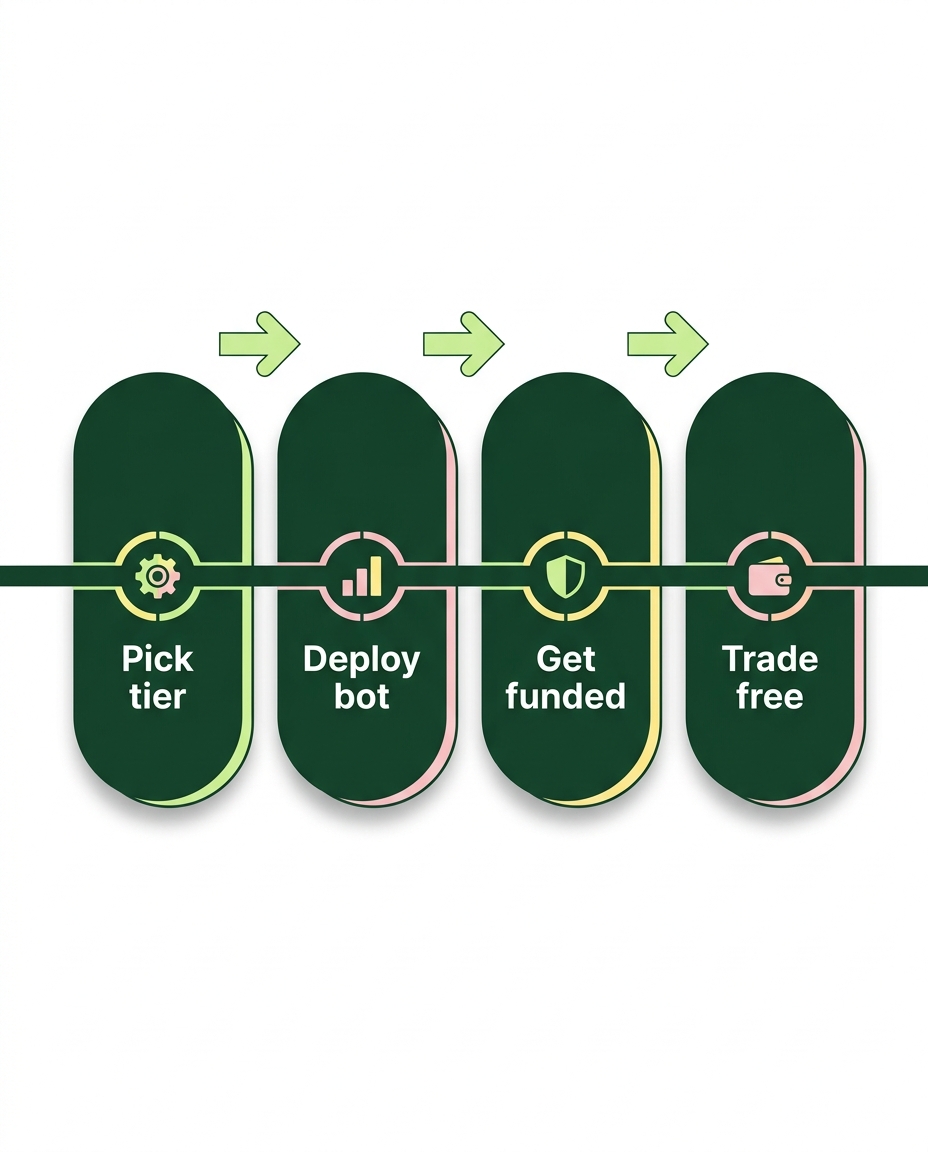
Getting Your Algo Live On A Funded Account
Pick Your Evaluation Tier
Choose Starter, Pro, or Expert based on the contract count your strategy is backtested around.
Deploy Your EA Or Bot
Run your automated strategy against the trailing drawdown and daily loss limit — no algo-specific restrictions apply.
Get Funded, Same Contracts
Move to a funded account with identical contract sizing — your risk model doesn’t need re-tuning.
Trade With No Rules Once Funded
Let the algorithm run within the account’s trailing limit — no minimum days, no profit target, no daily cap.
🤖 Fund Your Algo Trading Account →
⚠️ Risk Disclaimer: Trading futures — whether manually or through automated strategies, expert advisors, or bots — involves substantial risk of loss and is not suitable for all investors. Automated systems can execute losses as quickly as they execute gains; past backtested or live performance is not indicative of future results. Only trade with capital you can afford to lose, and consult a qualified tax professional in your jurisdiction (including France/EU-specific rules) before treating trading income as a settled tax position. This article is based on publicly available information as of July 2026.