Trading the Opening Range Breakout in Futures Markets
The First 15 Minutes Set the Tone for the Whole Session
Opening range breakout trading turns the market’s first burst of volume into a repeatable, rules-based edge — here’s how to build one that survives a funded account.
Table of Contents
- Trade using TickWise allocated capital
- Guaranteed payout
- Unlimited withdrawals, anytime
Every futures session has a moment where the noise clears and direction shows up. For most index and commodity contracts, that moment lands in the first 15 to 30 minutes after the open. Overnight positioning, economic releases, and pre-market speculation all collide, and the range that forms in those opening minutes tends to define the rest of the day. Traders who build a plan around that range — rather than guessing at direction from the first tick — are trading the opening range breakout (ORB).
This isn’t a secret indicator or a black-box system. It’s one of the oldest structural edges in futures trading, and it works because of how liquidity actually behaves at the open, not because of some curve-fitted backtest. If you’re building a futures trading strategy for a funded account, ORB is worth understanding in detail before you risk a single evaluation attempt.
🚀 Start Your TickWise Evaluation →
What Is an Opening Range Breakout?
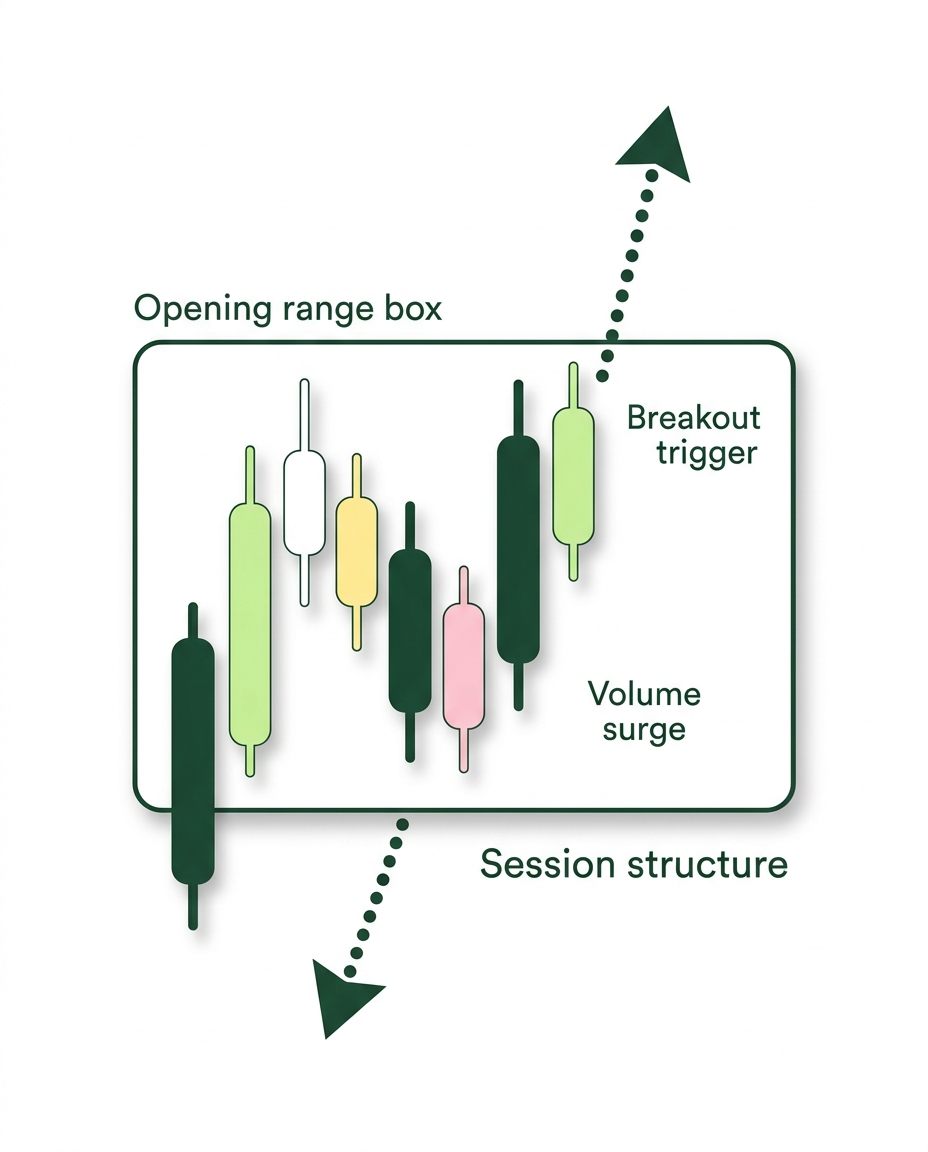
The opening range is simply the high and low price established during a defined window at the start of the regular trading session — commonly the first 5, 15, or 30 minutes. Once that range is set, the strategy is mechanical: a close (or a print, depending on your rules) above the range high triggers a long, and a break below the range low triggers a short.
The logic is straightforward. The opening range absorbs the first wave of institutional orders, overnight gap information, and algorithmic rebalancing. When price actually breaks that range with conviction, it usually means real directional flow is behind the move — not just early-session chop. That’s the entire premise: fade the range while it holds, follow it once it breaks.
💡 Why it holds up across decades: ORB isn’t dependent on any single indicator or platform. It’s been documented and traded on ES, NQ, CL, and GC futures for years because it captures a structural feature of market open — not a temporary inefficiency that gets arbitraged away.
Why the Open Behaves Differently Than the Rest of the Day
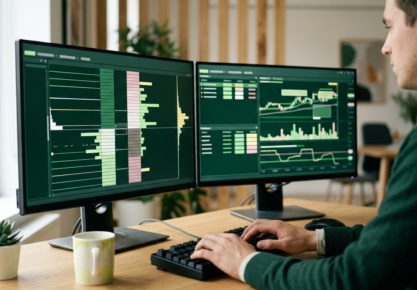
Volume at the open is disproportionately high relative to any other 15-minute window in the session. Overnight futures trade on thin volume, so when the regular session opens, resting orders, gap-fills, and news reactions all hit the tape at once. That concentration of activity creates genuine price discovery — the market is figuring out where value actually is for the day.
Once that discovery process resolves into a breakout, momentum traders, algos chasing the move, and stop-loss orders from the other side all get pulled in the same direction. This is why ORB breakouts, when they hold, tend to produce some of the largest intraday moves of the session. It’s also why a solid grasp of volume profile analysis pairs naturally with an ORB approach — you can see exactly where that opening volume concentrated and use it to judge whether a breakout has real support behind it.
15-30 min
Typical Range Window
40-55%
Realistic Win Rate
ES / NQ
Most Common Contracts
11:30 ET
Common Cutoff Time
Building the ORB Setup Step by Step
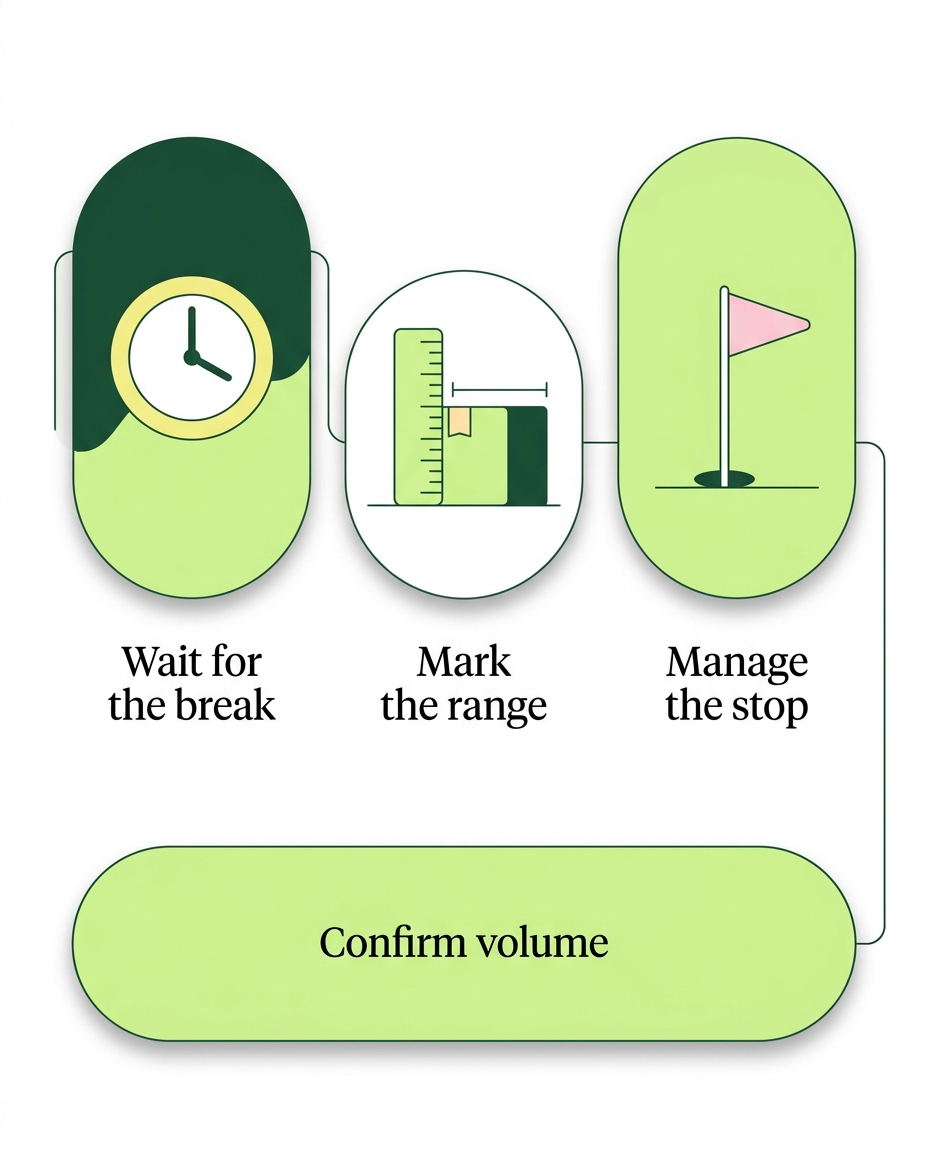
A tradeable ORB system needs four fixed components, decided in advance and never adjusted mid-session:
1. Define the Range Window
Pick one window and stick with it — the first 15 minutes after the cash open is the most common choice for ES and NQ. Shorter windows (5 minutes) produce more signals but more false breaks; longer windows (30 minutes) produce fewer, cleaner signals.
2. Mark the High and Low
Once the window closes, the range high and low are locked. Draw them as horizontal lines and don’t redraw them once price starts moving — that’s where discretionary traders sabotage a mechanical edge.
3. Wait for Confirmation
Decide whether you’re trading the first touch of the level or waiting for a candle close beyond it. A close-based trigger filters out a large share of the fake breakouts that punish traders entering on the wick alone.
4. Size the Position Before You Need To
Know your contract count before the range even forms. Deciding size in the moment, adrenaline running, is how traders overleverage the one setup that was supposed to be systematic.
Position sizing matters more on ORB trades than almost any other setup, because the stop distance is fixed by the range width rather than by your own discretion. Reviewing a proper position sizing formula for prop firm accounts before you trade ORB live will save you from the single biggest way this strategy blows accounts: sizing a wide range the same way you’d size a tight one.
Entries, Stops, and Targets
🟢 Long Setup
- Range high broken with a confirmed close above it
- Stop placed just below the range low, or at the midpoint for tighter risk
- First target = range width projected from the breakout point
- Trail remainder using a higher-timeframe structure once in profit
🔴 Short Setup
- Range low broken with a confirmed close below it
- Stop placed just above the range high, or at the midpoint
- First target = range width projected downward from the break
- Scale out into the first strong momentum push
One rule that consistently improves ORB performance: take only one attempt per direction per session. If the breakout fails and price snaps back into the range, don’t re-enter the same direction on a second push — that’s usually a liquidity sweep, not a real continuation. This ties directly into risk management for funded futures traders, where limiting your number of attempts per session is one of the simplest ways to keep a losing morning from becoming a blown drawdown.
🚨 Watch for this: The most common way ORB traders lose money isn’t a bad breakout — it’s chasing a second or third entry after the first one fails. Range width doesn’t change, but your account’s tolerance for repeated losses does. Set a hard cap of one long attempt and one short attempt per session and hold to it mechanically.
Filters That Separate Winners From Noise Trades
Raw ORB, traded with no filters, tends to hover around a 40% win rate — profitable only because winners run further than losers cost. Adding a couple of filters meaningfully improves the picture without turning the system into a discretionary mess:
Filters Worth Adding
- Higher-timeframe trend bias (daily close vs. 20-day average)
- Time cutoff — skip breakouts after late morning
- Minimum range width to avoid trading inside noise
- Volume confirmation on the breakout candle
Filters That Overcomplicate It
- Stacking five-plus indicators on one chart
- Adjusting rules mid-session based on « feel »
- Different range windows for different days
- News-based discretionary overrides without a plan
The trend filter is the single highest-value addition. Only taking long breakouts when the market is already above its recent average, and only taking shorts when it’s below, cuts a large share of counter-trend failures where the breakout fires straight into an established opposing trend. If you’re building this into an automated or semi-automated workflow, cross-referencing with how futures move during high-impact news events will help you decide whether to skip ORB entirely on CPI or FOMC mornings, where the range itself can be manipulated by pre-release positioning.
Trading ORB on a Funded Account
Opening range breakout trading fits cleanly into the structure of a funded futures account, mostly because it’s naturally low-frequency. You’re not scalping forty times a day — you’re taking one or two high-conviction trades in the first hour and then stepping away or managing runners. That discipline matters more once real evaluation rules are attached to your trading day.
The best time of day to actually take these trades matters as much as the setup itself. Reviewing a session guide on the best time to trade futures for prop traders will help you decide whether you’re built for the volatility of the US cash open or whether a later, calmer window suits your evaluation better.
Drawdown type also changes how forgiving ORB is on a funded account. A strategy that risks a fixed stop distance on one or two trades a day behaves very differently under an intraday trailing drawdown than under an end-of-day model — understanding the difference between EOD and intraday trailing drawdown before you start trading ORB live will keep a single wide-stop loss from doing more account damage than the setup ever intended.
TickWise Funding Plans — Choose Your Path
one-time
| Account Size | $25,000 |
| Contracts | 3 |
| Funded Target | $2,500 |
| Once Funded | NO RULES ✓ |
one-time
| Account Size | $50,000 |
| Contracts | 6 |
| Funded Target | $5,000 |
| Once Funded | NO RULES ✓ |
one-time
| Account Size | $100,000 |
| Contracts | 10 |
| Funded Target | $10,000 |
| Once Funded | NO RULES ✓ |
All plans: real allocated capital · guaranteed payouts · unlimited withdrawals · 90+ currencies & crypto
Common Mistakes That Wreck the Strategy
Before You Trade ORB Live, Check This
- Range window fixed and written down before market open
- Stop distance calculated before the breakout, not after
- One long attempt, one short attempt maximum per session
- Trend filter applied consistently, not selectively
- Position size matched to today’s range width, not yesterday’s
- News calendar checked for high-impact releases during the window
The most expensive mistake isn’t a wrong read on direction — it’s treating a mechanical system like a discretionary one. Traders who redraw their range mid-session, widen their stop after entry, or take a third attempt because « it feels like it’s about to go » are the ones who turn a 45% win-rate edge into a losing month. ORB rewards traders who define the plan before the bell rings and refuse to touch it afterward.
✅ Bottom line: Opening range breakout trading is one of the few futures setups that’s simple enough to execute under pressure and structural enough to hold up across market conditions. Build the rules once, size correctly, and let the first hour of the session do the work.
What’s the best opening range window — 5, 15, or 30 minutes?
Most traders on ES and NQ use 15 minutes as the default. A 5-minute range produces more signals but more false breaks; 30 minutes produces fewer, more reliable signals but you’ll miss faster moves. Test both against your own contract before committing.
Does ORB work on commodities like gold and crude oil, not just index futures?
Yes, though the opening window differs by contract since GC and CL don’t share the same cash-session open as ES and NQ. The core logic — a defined range followed by a confirmed break — applies to any liquid futures contract with a clear session open.
Should I trade every ORB signal or only the highest-conviction setups?
Selectivity improves results. Combining a trend filter with a minimum range width and a time cutoff will cut your trade count roughly in half while improving your win rate — fewer noise trades, more setups with real flow behind them.
How does drawdown type affect an ORB strategy specifically?
Since ORB stops are often wider than a scalping stop, an intraday trailing drawdown can penalize a single losing breakout more harshly than an end-of-day model would. Match your position size to your drawdown type, not just the range width.
A Simple Path to Funded Trading
Choose Evaluation
Select the account size that matches your trading style — Starter, Pro, or Expert.
Trade Safely
Focus on performance while respecting a clear, defined risk structure.
Get Funded
Access a funded account with allocated capital and trade with confidence.
Withdraw Profits
Request payouts freely — no withdrawal limits, 90+ currencies and crypto supported.
If you’re ready to put a rules-based setup like ORB in front of real allocated capital, start with an evaluation that matches your account goals. Once funded, there are no scaling rules or profit caps standing between you and your next payout — just a straightforward path to getting started with TickWise.
💰 Trade Your Edge on Real Capital →
⚠️ Risk Disclaimer: Trading futures involves substantial risk of loss and is not suitable for all investors. Past performance is not indicative of future results. Only trade with capital you can afford to lose. This article is for educational purposes and does not constitute financial advice.