Best Prop Firm for Part-Time Traders: Trade Around Your Job
You Don’t Need to Watch Charts All Day to Get Funded
A real weekly schedule, transparent pricing, and a firm that doesn’t punish you for having a 9-to-5.
Table of Contents
The best prop firm for part-time traders is one with no minimum daily screen time, no forced same-day exits, and pricing that doesn’t bleed you dry while you learn on evenings and weekends. TickWise Funding fits that brief: a one-time evaluation fee ($190/$290/$490), overnight and weekend holding allowed on futures, a trailing drawdown you can manage in 30-60 minute windows, and zero behavioral rules once you’re funded. If you’ve got a full-time job and a couple of hours a day, this is the model built for you — not for someone glued to five monitors from 9:30 to 4.
Most prop firm marketing assumes you can trade all day. Minimum trading-day requirements, tight time-limited challenges, and CFD platforms with rolling overnight financing costs all quietly favor full-time traders. A part-timer with a 9-to-5 needs something different: fixed contract sessions, a risk model that doesn’t require constant monitoring, and no artificial deadline forcing you to overtrade on your lunch break.
This article lays out exactly how a part-time trader can build a repeatable weekly routine around futures market hours, why futures beat CFDs for people who check in twice a day instead of watching a live feed, how TickWise’s trailing drawdown actually behaves when you’re at work, and what changes (and what doesn’t) once you get funded.
We’ll also cover the plan pricing in full — no vague « starting at » language, just the real numbers: $190 for a 3-contract $25K evaluation, $290 for 6 contracts on $50K, and $490 for 10 contracts on $100K. Same contract count in evaluation and funded phase, so your trading power never changes once you pass.
- Trade using TickWise allocated capital
- Guaranteed payout
- Unlimited withdrawals, anytime
What Makes a Prop Firm Part-Time Friendly
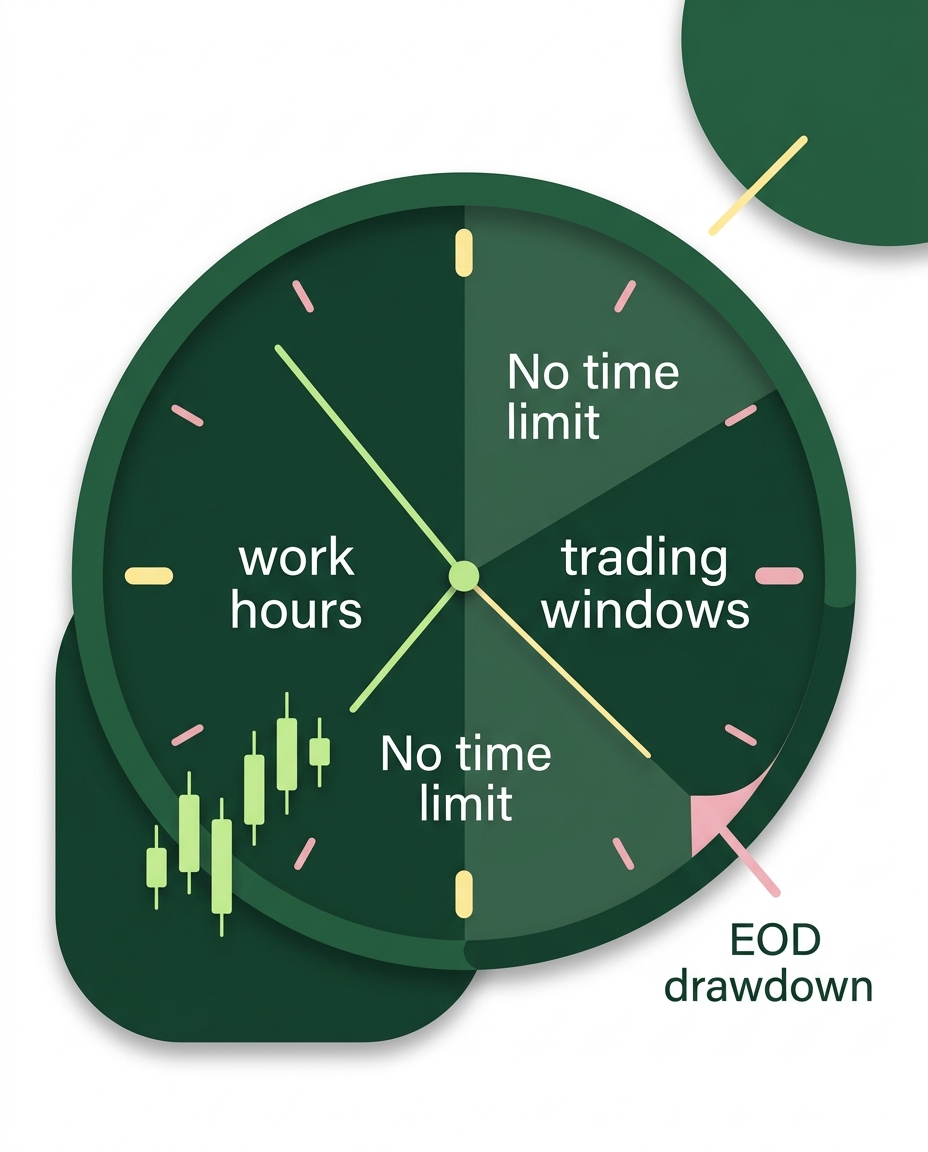
A genuinely part-time-friendly prop firm removes the three biggest obstacles a working trader faces: rigid time limits, mandatory daily activity, and rules that assume you’re staring at a screen for eight straight hours. Look for a flexible prop firm evaluation with no hard expiry date, a low minimum trading-days requirement (or none at all), and a risk model based on end-of-day account balance rather than tick-by-tick intraday monitoring.
TickWise’s evaluation structure requires only 10 active trading days during the challenge and 5 during the funded-preparation stage — spread across however many weeks you need. There’s no countdown clock forcing you to jam trades into a single frantic week. That single design choice is what separates a genuine prop firm no time limit challenge from firms that quietly cap you at 30 or 60 calendar days.
What to check before picking a part-time-friendly firm
- No hard evaluation expiry date, or a generous one measured in months
- Low or no minimum trading-days requirement
- End-of-day (not real-time) drawdown calculation
- Overnight and weekend position holding allowed
- Transparent, one-time pricing — not a recurring subscription trap
- No behavior restrictions once you’re actually funded
Swing trading and short scalps both work under this model. A swing trading prop firm approach — holding positions overnight through the Globex session — suits someone who can only place an order before work and check it after dinner. TickWise supports both styles because the account rules don’t dictate your holding period; they just track your equity against a defined limit.
Best Prop Firm for Part-Time Traders: A Real Weekly Schedule
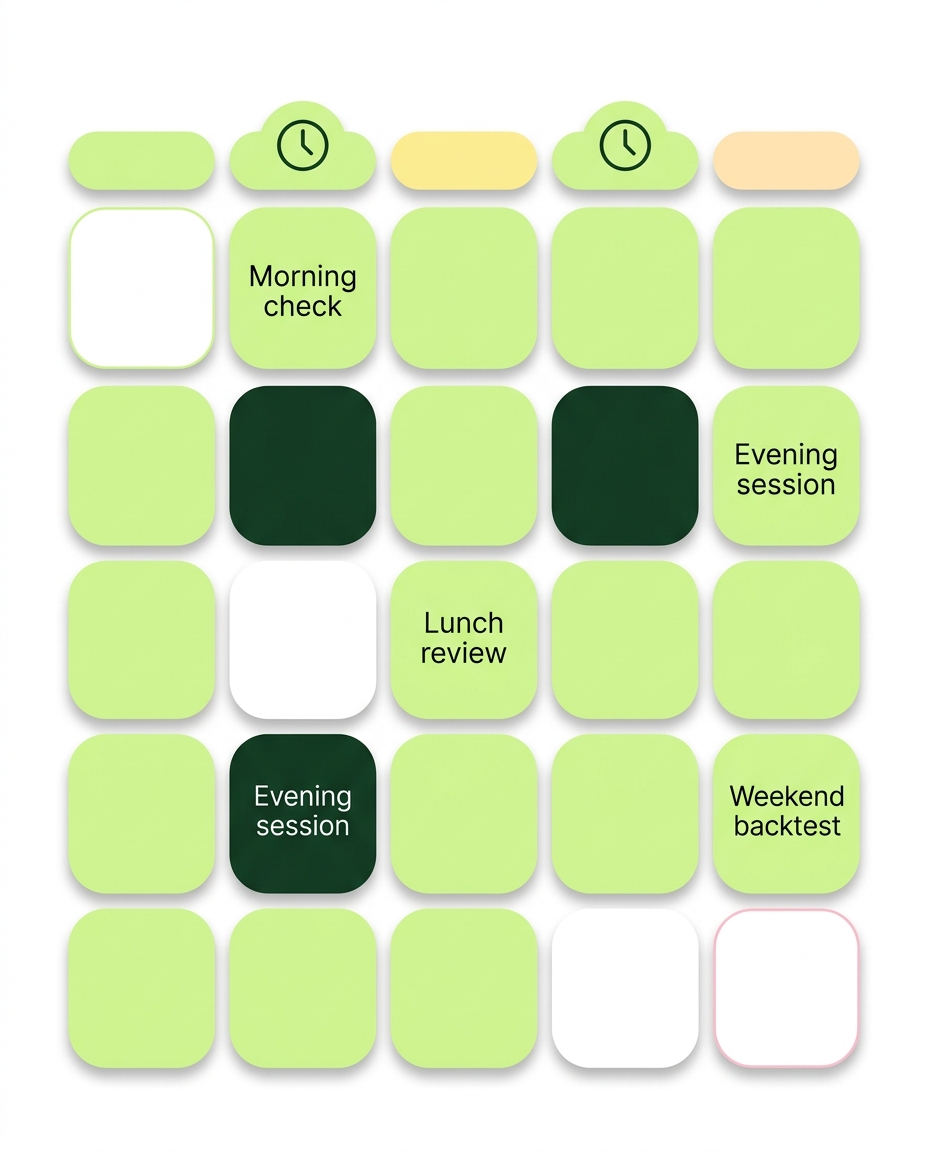
Here’s a schedule an actual part-timer with a 9-to-5 can run, week after week, without burning out. It leans on mapping out Globex and RTH session hours so every session lines up with time you actually have free.
| Day | Window | What You Do |
|---|---|---|
| Monday | 7:00-8:15am (pre-work) | Review weekend gap, set alerts for the RTH open at 9:30am ET |
| Tuesday | 9:30-9:50pm (Globex evening) | Trade the overnight session opening range on ES/NQ micros |
| Wednesday | Lunch break, 12:00-12:30pm | Check open positions, adjust stops, no new entries |
| Thursday | 7:30-8:15am | Trade the RTH cash open volatility window before commuting |
| Friday | 6:00-7:00pm | Close or trail positions before the weekend, journal the week |
| Weekend | 1 hour, Saturday | Backtest, review trade log, plan next week’s levels |
Two 30-45 minute windows on trading days, one lunch check, one weekend review — that’s roughly 4-5 hours a week. It’s enough to hit TickWise’s 10-day evaluation minimum inside a month without ever touching a chart during work hours. The key is choosing one or two session windows (RTH open or the Globex evening session) and repeating them, rather than trying to watch every hour of the day.
This is also where the trade around a full-time job mindset really pays off: fewer decisions, made at the same time each day, in a market session you’ve studied. It beats trying to squeeze in random five-minute glances between meetings.
CFDs vs Futures: Why Fixed Sessions Matter for Part-Timers
Most retail CFD brokers run near-24-hour markets with rolling overnight financing charges that accrue whether you’re watching or not. For a futures prop firm part time trader, that’s the wrong tool. Futures contracts trade on fixed, published sessions (Globex overnight, RTH day session) with no daily financing drag — you know exactly when the session opens, closes, and rolls, and your holding cost doesn’t quietly erode a position you can only check twice a day.
We’ve gone deep on why futures beat CFDs for fixed sessions elsewhere, but the short version for part-timers: CFD accounts are built for people who can react to a market open 24 hours a day. Futures give you defined windows that match a work schedule — trade the open, walk away, come back for the close.
Best prop firm for part-time traders with a full-time job — does session type matter?
Yes. If your firm’s underlying instrument trades around the clock with financing costs, every hour you’re not watching is an hour something can quietly work against you. Futures contracts on a defined session mean your risk is capped to a known window, which is exactly what someone checking in before and after work needs.
Trailing Drawdown Rules When You Can’t Watch Screens All Day
This is the single biggest technical detail that trips up part-time traders. Not all trailing drawdown is calculated the same way, and the difference decides whether an unmonitored position can quietly end your account. We break this down in full in how trailing drawdown rules actually work, but here’s what matters for someone who can’t sit at a screen all day.
TickWise calculates trailing drawdown against your end-of-day balance, not your real-time tick-by-tick peak. That means an intraday spike in open profit that reverses before the close doesn’t lock in a tighter drawdown limit the way a real-time intraday trailing system would. For a part-timer who places a trade before work and can’t babysit it during an 8-hour shift, that distinction is the difference between a manageable risk buffer and a limit that can vanish while you’re in a meeting.
💡 Why this matters for part-time traders: If your firm uses real-time intraday trailing drawdown, an unrealized profit spike you can’t see or react to becomes your new floor. End-of-day calculation gives you a fixed, known cushion for the whole session — exactly what you need when you’re not watching.
Pair that with a defined prop firm overnight holding rules policy that actually permits holding through the close and into the next session, and you get a structure that doesn’t force you to flatten everything at 3:58pm just because you have a job. Add a tight, disciplined tactic like quick scalping setups for short sessions for the days you only have 20 minutes, and you have a complete toolkit — swing trades for the days you can hold overnight, scalps for the days you can’t.
How to trade futures prop firm part time without constant screen time
Use limit orders and pre-set stop-losses so your risk is defined the moment you place the trade, not something you manage live. Combine that with an end-of-day trailing drawdown model and you can walk into work knowing your maximum loss for the day is already capped — no screen required.
Best Prop Firm for Part-Time Traders: Full Plan Pricing
Transparency matters more for part-timers than anyone — you’re investing evenings and weekends, not full-time hours, so the cost has to be worth it. Here are TickWise’s real numbers, no vague « starting at » language:
TickWise Funding Plans
one-time
| Account Size | $25,000 |
| Contracts | 3 |
| Funded Payout Level | $2,500 |
| Min. Trading Days | 10 eval · 5 prep |
| Once Funded | NO RULES ✓ |
one-time
| Account Size | $50,000 |
| Contracts | 6 |
| Funded Payout Level | $5,000 |
| Min. Trading Days | 10 eval · 5 prep |
| Once Funded | NO RULES ✓ |
Expert — $490 one-time
For part-timers ready to scale their evening and weekend routine into serious contract size.
- $100,000 evaluation account
- 10 contracts
- $10,000 funded payout level
- 10 eval days · 5 prep days minimum
- Same 10 contracts in the funded phase — no reduction
All plans: one-time fee · same contracts in evaluation and funded phase · guaranteed payouts
Notice the pattern: whatever contract count you evaluate with, that’s what you trade once funded. Same contracts in both phases means your trading power stays constant — no surprise scaling restrictions after you pass. For a full breakdown of which tier fits your available hours and risk tolerance, see comparing the $190, $290 and $490 tiers.
Prop firm no minimum trading days for part-time traders — does TickWise qualify?
TickWise still asks for 10 active days in the evaluation and 5 in the funded-preparation stage, but there’s no calendar deadline attached. You can spread those 15 days across two months if that’s what your job allows — the requirement is about proving consistency, not speed.
No Rules Once Funded: The Freedom Part-Timers Actually Need
Passing an evaluation is only half the story. Many firms quietly add scaling plans, consistency rules, or minimum-activity requirements to the funded account — restrictions that can quietly disqualify a part-timer who trades in bursts around a job. TickWise removes that entirely: once you’re funded, there’s no minimum trading frequency, no consistency percentage rule, and no forced scaling schedule. You simply trade within your account’s drawdown limit.
✅ What actually disappears once you’re funded: minimum trading-days requirements, evaluation profit targets, and time-limit pressure. What stays: the drawdown limit itself — that never goes away, funded or not, because it’s what protects the allocated capital.
That structure matters enormously if your available trading hours shift week to week — a busy sprint at work, a vacation, a slow month. A firm that penalizes inactivity punishes exactly the traders this article is written for. TickWise’s model rewards discipline within the drawdown, not raw frequency.
Prop firm flexible evaluation time limit part-time — what changes after funding?
The flexibility that got you through the evaluation carries over. There’s no new clock that starts ticking once you’re funded, and no requirement to trade every single day to keep the account active.
FAQ: Best Prop Firm for Part-Time Traders
What is the best prop firm for part-time traders who have a full-time job?
The best fit is a futures prop firm with no hard evaluation deadline, a low minimum trading-days requirement, end-of-day trailing drawdown calculation, and no behavioral restrictions once funded. TickWise Funding is built around exactly that combination, with transparent one-time pricing at $190, $290, or $490.
Best prop firm for traders with limited screen time — what should I prioritize?
Prioritize end-of-day (not real-time) drawdown calculation, overnight and weekend holding permissions, and a firm that doesn’t require you to be active every single trading day. Screen-time limited traders need a risk model that doesn’t punish them for stepping away between checks.
Can I hold positions overnight or over the weekend as a part-time futures trader?
Yes. TickWise’s part-time futures trading prop account permits overnight and weekend holding on futures contracts, which is essential if your only available trading windows are before work, after work, or during a Globex evening session.
What happens once I pass the evaluation and get funded?
Your contract count carries over unchanged, the minimum-trading-days requirement drops away, and there are no new behavioral restrictions — just the drawdown limit that protects the allocated capital. See what changes once you’re funded for the full breakdown.
Is there a no time limit prop firm challenge option for part-timers?
TickWise’s evaluation has no hard expiry date — you complete the required 10 trading days at your own pace, whether that’s two weeks or two months, making it effectively a no time limit prop firm challenge for anyone trading around a job.
A Simple Path to Funded Trading
Choose Evaluation
Pick the $190, $290, or $490 tier based on the contract size and hours you realistically have each week.
Trade Your Schedule
Run your RTH-open or Globex-evening routine, respecting the end-of-day trailing drawdown limit.
Get Funded
Same contract count carries over — your trading power doesn’t shrink once you pass.
Trade Without New Rules
No minimum activity, no scaling surprises — just the drawdown limit and unlimited withdrawals.
Ready to build your part-time trading routine around a real evaluation? getting your first evaluation started takes a few minutes.
🚀 Start Your TickWise Evaluation →
⚠️ Risk Disclaimer: Trading futures involves substantial risk of loss and is not suitable for all investors. Past performance is not indicative of future results. Only trade with capital you can afford to lose. This article is for educational purposes and reflects TickWise Funding’s plan structure as of July 2026.