Advanced Futures Trading: Techniques for Experienced Prop Traders
Once Funded, The Rulebook Disappears
Advanced futures trading strategies for prop traders only pay off when the account structure lets you actually run them. Here’s what changes the day you go from evaluation to funded.
Table of Contents
Advanced futures trading strategies for prop traders center on techniques that only become viable once trading restrictions lift — correlated multi-contract spreads (ES+NQ, GC+CL), overnight/swing position holds, algorithmic execution, and trailing-drawdown-aware scaling. Experienced prop traders use these techniques to extract more edge per trade than single-contract, intraday-only approaches allow, but only after clearing evaluation and reaching a funded, rules-free account.
Most prop firm content treats « advanced strategy » as a synonym for exotic chart patterns. That’s not where the real edge lives for funded futures traders. The edge lives in structure — in understanding exactly what your account allows and building techniques around it rather than around generic strategy checklists. For context on the fundamentals underpinning all of this, the broader prop trading fundamentals are worth reviewing before layering on anything advanced.
This article is built specifically for traders who have already passed an evaluation, or who are close to it, and who want to know which advanced futures trading techniques are realistically deployable on a funded TickWise account — and which ones only make sense at certain account sizes. We’ll cover correlated multi-contract portfolios, trailing drawdown mechanics as they relate to position sizing, overnight and swing holds, algorithmic execution, and how to map all of it against the $190 Starter, $290 Pro, and $490 Expert plans.
The unifying theme: TickWise’s « no rules once funded » philosophy means the moment you’re trading allocated capital, restrictions that exist during evaluation at most prop firms — no overnight holds, no algo execution, capped correlated exposure — simply aren’t there anymore. Same contracts in both phases means the trading power you built your evaluation habits around carries straight through, but the ceiling on what you can do with that power rises sharply.
🚀 Start Your Funded Evaluation →
- Trade using TickWise allocated capital
- Guaranteed payout
- Unlimited withdrawals, anytime
What Advanced Techniques Do Experienced Prop Traders Actually Use
Ask ten experienced futures traders what « advanced » means and you’ll get ten different answers involving Fibonacci clusters, volume profile, or order flow. Those are tools. Advanced futures trading techniques, in the context of a funded prop account, are really about capital deployment decisions layered on top of whatever entry method you already trust.
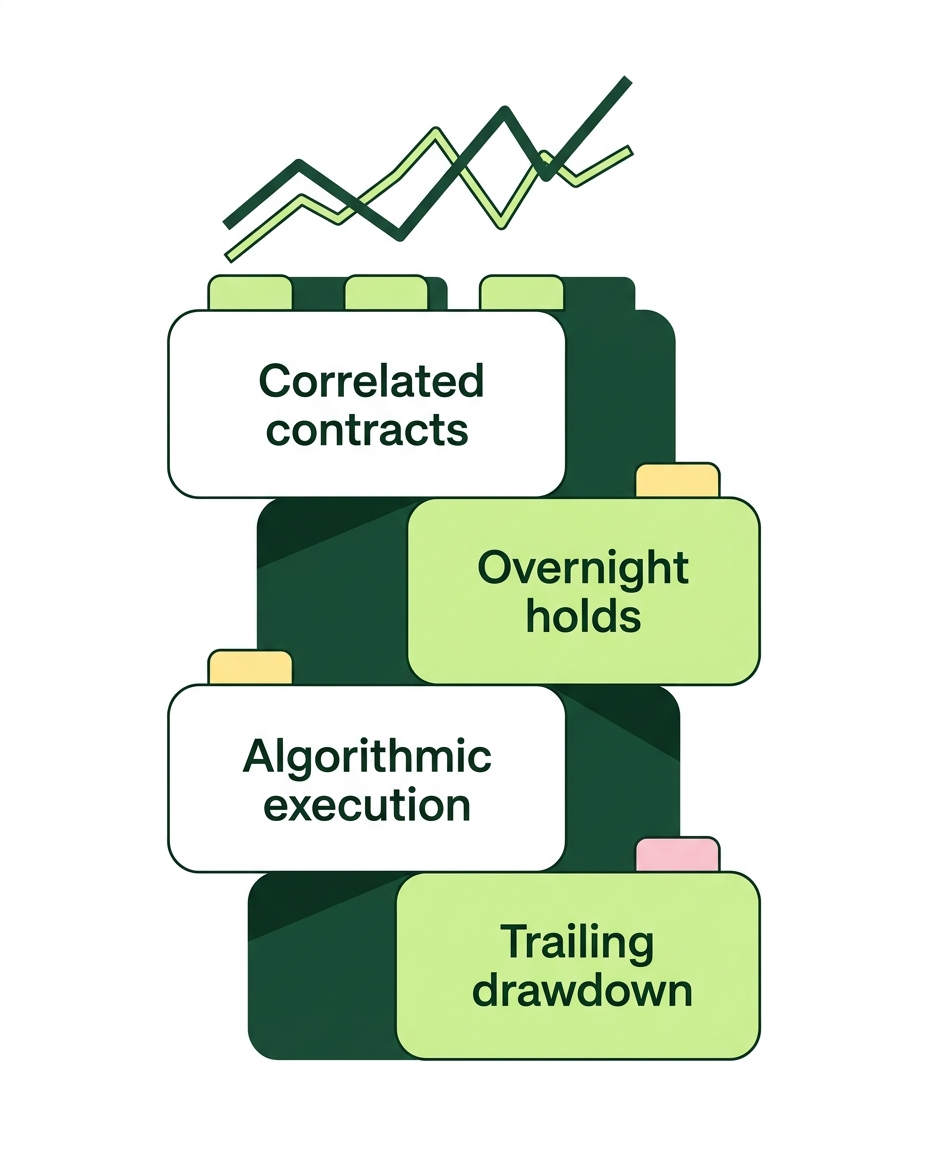
Four techniques repeatedly separate experienced prop trader strategies from beginner ones once an account is funded: running correlated multi-contract positions across related markets (ES+NQ, GC+CL) instead of one instrument at a time; holding positions overnight or across multiple sessions when the setup calls for it instead of forcing a flat close every day; deploying algorithmic or semi-automated execution to remove emotion and improve fill consistency; and scaling size deliberately around the account’s trailing drawdown behavior rather than around a fixed lot-size habit.
None of these are exotic. What makes them « advanced » is that they require an account structure that doesn’t punish you for using them. That’s precisely what changes once you get funded on a no-rules model — the techniques were always known, they just weren’t accessible during evaluation-style restrictions at most firms.
It’s also worth separating futures scalping vs trend following as a first strategic fork. Scalping suits traders who want rapid, session-bound execution and lower per-trade risk — well matched to smaller accounts and tighter trailing drawdown cushions. Trend following, by contrast, benefits from wider stops, multi-day holds, and larger drawdown buffers, which makes it a more natural fit once you’re funded on a Pro or Expert-sized account. Neither is objectively « more advanced » — the skill is matching the style to the account mechanics you’re actually trading under.
Advanced Risk Management Futures Trading: Correlated Multi-Contract Portfolios
The single biggest content gap in prop firm education is correlated portfolio risk. Nearly every guide treats « position size » as a single-instrument decision. Experienced prop traders rarely trade in isolation — they build small portfolios of related contracts, and that changes the risk math entirely.
Consider an ES + NQ combined position. Both are equity index futures with a correlation coefficient that frequently sits above 0.85. Trading both long simultaneously doesn’t diversify your risk — it concentrates it. A move against equities hits both positions at once, and your effective drawdown exposure is closer to the sum of the two than either one alone. The same logic applies to GC (gold) and CL (crude oil) pairings during macro-driven sessions, where both can move together on dollar-strength days even though they’re nominally « different markets. »
Advanced risk management futures trading means sizing each leg of a correlated position as a fraction of what you’d risk on a single-instrument trade — not as two independent full-size positions. A practical starting rule: if two instruments have historically moved together more than 70% of the time on a given session, treat their combined position as a single risk unit and size accordingly against your account’s drawdown cushion, not against each instrument’s standalone volatility.
This is where account size matters concretely. A Starter account with 3 contracts and a $1,500 trailing drawdown has very little room to run a genuine two-leg correlated position at meaningful size — you’re better off keeping the Starter tier single-instrument. A Pro account’s 6 contracts, or an Expert account’s 10, give you the room to split exposure across two correlated instruments while still respecting the same disciplined per-leg sizing.
Trailing Drawdown Advanced Strategies for Position Sizing and Scaling
Trailing drawdown mechanics should directly reshape how an experienced trader thinks about position sizing — and this is a second area competitors rarely connect concretely to strategy. Because the drawdown floor rises with your peak equity but never falls, every winning trade permanently narrows your future risk cushion. That’s fundamentally different from a static drawdown model, and it means aggressive scaling right after a winning streak is exactly when you need the most discipline, not the least.
For a full breakdown of the mechanics themselves, how trailing drawdown actually behaves is essential reading before you attempt any of the scaling techniques below.
Practically, trailing drawdown advanced strategies come down to a few rules experienced traders apply consistently:
Trailing Drawdown-Aware Scaling Checklist
- Scale contract size up only after your trailing floor has moved far enough to absorb a full stop-loss at the new size
- Reduce size, don’t increase it, immediately after your largest win of the month — the cushion is tightest relative to your new floor
- Size correlated multi-contract positions against the trailing floor’s remaining distance, not the account’s original starting balance
- Treat every new equity high as a new starting point for risk calculations, not the account’s initial size
- Keep a hard per-trade risk ceiling as a percentage of remaining drawdown room, recalculated weekly
This is also where algorithmic futures trading prop firm execution becomes genuinely useful rather than a novelty — an algo can enforce these sizing rules mechanically, where a discretionary trader under pressure after a big win is the most likely to override their own plan.
Overnight and Swing Holds: What « No Rules Once Funded » Actually Unlocks
During most prop firm evaluations, overnight and multi-day holds are either banned outright or penalized through reduced buying power. That single restriction eliminates an entire category of advanced futures trading techniques — swing entries around key levels, holding through an overnight gap on conviction, or riding a trend across a weekend gap in gold or crude.
Once funded on a no-rules account, holding trades past the close becomes a live option rather than a violation. That doesn’t mean every funded trader should start holding overnight by default — it means the technique is now available to traders whose edge genuinely benefits from it, which is a different decision than being structurally blocked from testing it.
Practically, overnight and swing holds interact directly with trailing drawdown room. A position held overnight is exposed to a gap that a purely intraday position never sees, so the size of any overnight hold should be smaller than an equivalent intraday position at the same conviction level — precisely because the trailing floor doesn’t reset and a gap-driven loss narrows your future room permanently. Experienced traders typically cut overnight size by 30-50% relative to their intraday equivalent on the same instrument, specifically to protect the trailing cushion against unmanaged gap risk.
Session timing matters here too. London-open and New York-open overlaps produce the highest-volume, most liquid windows for entering swing positions with tighter slippage — entering a multi-day GC or CL position during a low-liquidity Asian session, versus during the London/NY overlap, can materially change your effective entry price and initial risk.
Algorithmic Futures Trading for Prop Firm Accounts
Algorithmic and semi-automated execution is another technique that’s functionally restricted during most evaluations — bot-driven entries and automated scaling logic often trip rule violations tied to « consistency » requirements or minimum trading day structures. Once funded and rules-free, deploying automated execution systems becomes a legitimate way to enforce the discipline outlined in the trailing drawdown section above.
The realistic use case for most experienced prop traders isn’t a fully autonomous black-box system — it’s a semi-automated layer that executes a discretionary thesis mechanically: fixed stop and target placement, automatic position-size reduction after a defined equity milestone, and hard daily-loss circuit breakers that don’t rely on the trader remembering to stop. This is where algorithmic futures trading prop firm setups add the most value — removing the emotional override risk that undermines even well-designed manual rules.
Account size again shapes what’s realistic. A single automated strategy running on a Starter account’s 3 contracts has limited room to run multiple correlated instruments simultaneously. A Pro or Expert account’s larger contract allocation gives an algo more room to manage a basket of 2-3 correlated futures at once without over-concentrating risk on any single trailing-drawdown budget.
Matching Advanced Techniques to Account Size: Starter, Pro, Expert
Futures trading strategies prop firm traders deploy shouldn’t be identical across account tiers — the contract allocation and trailing drawdown cushion available at each size genuinely change which techniques are sensible.
| Plan | Contracts | Funded Size | Realistic Advanced Techniques |
|---|---|---|---|
| Starter — $190 | 3 | $2.5K funded (from $25K eval) | Single-instrument swing holds, light algo rule enforcement, no correlated multi-leg positions |
| Pro — $290 | 6 | $5K funded (from $50K eval) | Two-leg correlated positions (ES+NQ or GC+CL) at reduced size, overnight holds, semi-automated execution |
| Expert — $490 | 10 | $10K funded (from $100K eval) | Full correlated multi-contract portfolios, calendar spreads, algo-managed basket positions, aggressive drawdown-aware scaling |
This is the pricing-to-strategy mapping most prop firm content skips entirely. A trader on a Starter account attempting a full ES+NQ correlated position with two-leg exposure is realistically over-extending a $1,500 trailing drawdown cushion. The same technique on an Expert account’s larger allocation has room to be executed responsibly.
Calendar spread and correlation strategies for prop firm futures traders — pairing a near-month contract against a further-out expiration on the same underlying, or running GC/CL correlation trades — are Expert-tier techniques specifically because they require enough contract allocation to hold both legs without over-concentrating the account’s drawdown budget on a single macro theme.
Once you’ve outgrown what a single funded account can support, the natural next step for experienced traders isn’t oversizing one account — it’s growing into a multi-account setup, running the same disciplined techniques across separate trailing-drawdown budgets instead of concentrating everything into one.
ℹ️ Tax & Regulatory Note: Advanced futures techniques, especially multi-contract and algorithmic execution, can carry different tax treatment than discretionary CFD trading depending on your jurisdiction. Traders based outside the US, including in France, should confirm local reporting requirements for futures gains with a qualified tax advisor before scaling size — this is separate from and in addition to TickWise’s account rules.
Frequently Asked Questions
What advanced techniques do experienced prop traders use to trade futures profitably?
Correlated multi-contract portfolios (ES+NQ, GC+CL), trailing-drawdown-aware position sizing, overnight and swing holds, and algorithmic execution are the four techniques most consistently used by experienced funded futures traders. Their profitability depends less on the technique itself and more on whether the funded account structure allows it without penalty.
How do experienced prop traders manage trailing drawdown with advanced strategies?
They treat every new equity high as the new baseline for risk calculations, reduce size immediately after large wins rather than increasing it, and size correlated or overnight positions against the remaining distance to the trailing floor rather than the account’s original balance.
What futures trading techniques become available once funded with no rules?
Overnight and multi-day holds, correlated multi-contract exposure, and algorithmic or semi-automated execution are typically restricted or penalized during evaluation at most prop firms. On a no-rules-once-funded account, all three become available the moment you’re trading allocated capital rather than evaluation capital.
Which TickWise account size is right for advanced futures strategies?
Starter (3 contracts, $190) suits single-instrument swing and algo-assisted trading. Pro (6 contracts, $290) supports two-leg correlated positions and overnight holds. Expert (10 contracts, $490) supports full correlated portfolios, calendar spreads, and algo-managed baskets. For help choosing the right account size, compare your intended technique against the contract allocation each tier provides.
Is portfolio correlation futures trading riskier than single-instrument trading?
It can be, if sized as though each instrument were independent. ES and NQ, or GC and CL, frequently move together, so a combined position should be sized as a single risk unit rather than as two full-size independent trades. Done correctly, correlated positions let experienced traders express a broader thesis without proportionally increasing drawdown exposure.
A Simple Path to Funded Trading
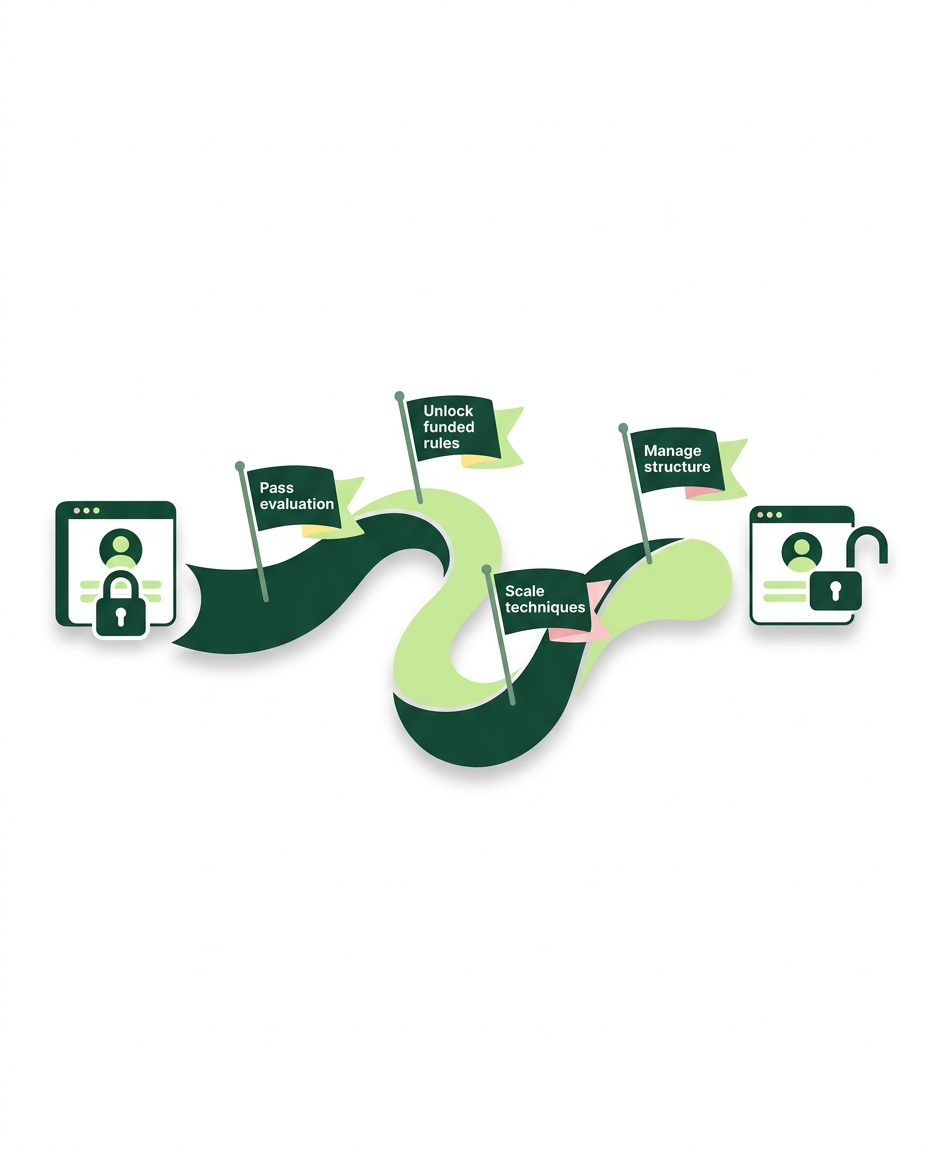
Choose Evaluation
Select the account size that matches the advanced techniques you intend to run — Starter, Pro, or Expert.
Trade Safely
Build consistent habits within a clear, defined risk structure during evaluation.
Get Funded
Access a funded account with allocated capital and no rules once funded — same contracts, more freedom.
Deploy Advanced Techniques
Layer in correlated positions, overnight holds, and algo execution as your account size supports them.
🚀 Start Your TickWise Evaluation →
⚠️ Risk Disclaimer: Trading futures involves substantial risk of loss and is not suitable for all investors. Advanced techniques such as correlated multi-contract positions, overnight holds, and algorithmic execution can increase both potential reward and potential loss. Past performance is not indicative of future results. Only trade with capital you can afford to lose, and confirm any tax or regulatory obligations with a qualified advisor in your jurisdiction. This article is based on publicly available information as of July 2026.